Arrived in San Francisco on Tuesday afternoon with no problems. This is a total relaxing week where I plan to do as little as possible, other than seeing friends, taking in a few museum shows, and doing a little nostalgic dining out at old and favorite haunts. First stop was San Mateo where I spent a fine evening with my twin brother, Scott and his lady, Bernadette. Scott made his party dish--lasagne, which was rich in cheese, meat and noodles. It's mother's jiggered recipe, an frankly it's better because Ma used cottage cheese and Scott insists sliced hard-boiled eggs! I'm absolutely sure I've stifled that memory, but I was grateful that they hadn't made it into Scott's version. The sheer cost of living in California has them more determined than ever to leave and re-locate to the Portland area. The house they are living in costs more than $400 a month for gas and electricity. Gas is, of course, higher here (about $3.79 at the pump vs. about $3.35 in Oregon).
I'm renting a room for three days in the private home of a San Franciscan resident, whose home is perched high up near Twin Peaks. Urging my rented little Mazda Matrix 2 (red, of course!) up those treacherous San Francisco hills is a tad unnerving, but eventually I made it. The owner, is a charming man, whose companion, a tiny long-haired Chihuahua named Finch, has already visited me several times in my room, staying for a nap while I watched a movie on my iPad last night. A retired CPA from the tech world, John owns a stucco triplex, and rents two of the rooms on the AIRnb.com website. $80 a night with a clean and well furnished room that is attractive and spacious. The room comes with the bathroom. The upstairs living room, dining area and kitchen are designed in one big open-plan with three huge windows that showcase one of the most spectacular views of the city imaginable. This shot was taken in the morning (we are having near-perfect weather--abundant sunshine, low 50s in the morning and getting up to about 60 in the day. Cool and comfortable), but at night the city is a lit jewel and the panoramic sight is stunning.
Up and out early this morning and decided to head over the the Castro area which is relatively close by for breakfast. I find San Francisco's "Gay Ghetto" diminished of energy since AIDS decimated the communities ranks in the 80s and 90s. Like everywhere else the real estate now rivals New York in cost. A one bedroom condo may have a little more space and amenities than in New York, but it will still set you back more than $600K. Two bedrooms easily takes you over the $million mark. An hour's worth of parking is $2.00 when you can find it. The city still remains one of the most difficult to maneuver around in a car and parking is virtually an impossibility, such as in Golden Gate Park, where I had hoped to take in a Rembrandt, Vermeer, Hals and other Dutch masters. No parking available, so I chose to make an emotional visit to Lonnie's next-door neighbor, Abbie.
When I arrived at the flat, Abbie was sitting outside on the stoop, reading a book and enjoying her morning coffee. She greeted me warmly, and we shared many memories of our good friend, who passed away at the end of March last year. Lonnie had lived in that flat for forty-seven years (Abbie's preceded him by two), and was a well-loved member of the community. Lonnie took very long walks every day stopping if he ran into a neighbor for a chat, sharing gossip of the neighborhood or exchanging information on parking cars, who perhaps a local crime or break-in. I asked Abbie, who had cleaned out the garage, a dumping ground for many of Lonnie's estate sale purchases, which he hoped to sell on Ebay. He did sell a lot, but he collected more. Lonnie was a pack rat and it toook Abbie more than three weeks to get rid of everything. They had a garage sale, and than whatever wasn't sold, was put on the sidewalk with a sign--FREE! The rest went to salvagers and city disposal.
Lonnie's garden was a tangle of trees planted with no thought as to form or the space in the back yard. It was a deep lot and could have been a wonderful haven, but Lonnie had no formal design in mind, nor did he spend much time out there. Abbie never enjoyed gardening, so the area had become an urban jungle with Cala Lillies growing everywhere; Ivy that was chocking every tree in the back yard, numerous jade plants, all gifts to Lonnie over the years. He would simply plant them in the back yard haphazardly. There was a giant Cymbidium orchid which in bloom produced more than 100 flowers, and Abbie was able to give it to one of Lonnie's friends, as it was in a large terra cotta pot. She didn't want the responsibility. She took up the round terra cotta stones and spent days clearing out the flora and much of the junk that had been left outside. I was astonished at the orderliness of this newly renovated garden. Lonnie would have preferred the mess, but it now looked beautiful and inviting, and I could imagine some chairs and a table and wondered why not put the bird bath in the middle of the garden instead of being up against the fence at the end. Lonnie's apartment has been renovated with a new kitchen and bathroom, and all fresh paint. Two students are now sharing the space and god knows what the rent is now, though the landlord is certainly due for as high a rent as he can charge, since Lonnie virtually paid nothing all those years.
With no parking near the De Young Museum, I went in search of lunch and there was one of my old reliables--Anchor Oyster Bar filled the bill nicely. This thirty-five year veteran of the Castro neighborhood, has been serving New England Clam Chowder, oysters, and other seafood specialties in it's pristine setting complete with marble bar, white tiled floors and walls, a mirrored menu above the kitchen, and about seven stainless steel tables. At night Anchor is packed with a sign-up board and a strict no seating of incomplete parties. At lunch it is a little more relaxed and I hitched myself to the bar with my Kindle reader ready to eat. Among the specials today was a toasted shrimp and Dungeness crab and melted cheddar cheese sandwich of a flattened square of Italian bread. This molten miracle has a little cayenne for some kick and it came with a nice green salad with a creamy garlic dressing. A nice Provencal Rose completed my lunch. Afterwards, I decided to check out more of the neighborhood. I am astonished at how sophisticated this neighborhood has become. I went to junior high school a few blocks away. During the 60s, this was an aging neighborhood of middle-class homeowners. The houses were beautiful and tightly shoe-horned. While there are the famous brightly painted Victorian homes along Dolores Street, when I was a kid, the colors were far more muted. Property values have skyrocketed to the point where people have made major investments in the look of the houses in the area, and it's a spectacular neighborhood, well-cared for. I saw one Victorian with a finished second floor, but the main floor and garage/basement, was completely gutted and the contractor and his workers were finished with the re-framing of the main floor. Another worker was installing new stairs. This renovation was extensive and most likely meant a huge mortgage or re-financing of an existing one.
The house pride of the city is quite remarkable. Along with Seattle, I don't think I've seen as wide a variety of beautiful, creative homes that are well maintained, with each looking so distinctive. Portland is more conventional in its architecture, whereas Seattle and San Francisco take a certain pride in the architectural specialness of their neighborhoods. I do have one complaint and it's been a complaint for many years. San Francisco has surprisingly fewer trees than in any other city I've ever visited. There are parks and hills that have abundant trees, but too many of the city's streets are lacking in trees and it looks odd to me. Portland, on the other hand, is wall-to-wall tree. You practically need permission to cut a tree down on your property and it will cost you a fortune to get rid of one.
My walk took me to shops, but I'm not really interested in shopping during this trip. Back at the house I'm more than halfway through THE END OF YOUR LIFE BOOK CLUB by Will Schwalbe, a colleague from my days at William Morrow. It is a very moving memoir about the last two years of his mother's life, and their mutual love of books (before launching his start-up website, Cookstr.com, Will had previously been editor-in-chief of Hyperion Books in New York). Their reading ranges widely and includes fiction, non-fiction, old classics and new. It's a remarkable tribute by a son to his mother, a woman who spent her life in academia, raised three kids, and traveled all over the world in support of refugees. It deserves all the glowing reviews it has received.
At eight, I began to think about dinner, and instantly I determined that I would to another old favorite--Zuni Cafe. Amazingly, this mainstay of upper Market Street, is thirty-three years old. Founding chef, Judy Rodgers, still presides over the kitchen. I can't tell you the last time I ate there--was it really back in the 90s? I have Judy's cookbook in my kitchen, and I've cooked from it infrequently over the years, particularly the restaurant's famous roast chicken with arugula salad and large bread croutons. It somewhat reminds me of Union Square Cafe in New York in that it was one of the first restaurants to buy its products from local farmers. Chez Panisse, which is probably forty years old now, pioneered this farm-to-table concept in American restaurants, and it has had an enormous influence ever since. The large, and spacious location has been renovated and is no longer quite as rustic looking as it was during its formative years. The menu is beautifully conceived, and as I read it, I honestly didn't see anything that I wouldn't have wanted to eat.
I wanted oysters tonight, and Zuni Cafe offers a wide variety. I chose three, two local and one from Washington plus two Little Neck clams which made me nostalgic for New York. Served with a mignonette sauce using an excellent quality vinegar, it was all the oysters needed to please. The bread served here is a rustic sourdough whole wheat bread, which Rodgers insists should have the most crackling crust imaginable--and it does. The inside manages to be both chewy and tender and had this lightly sour, yeasty, wheat flavor that made me inhale it all. Served with good butter, it was delicious with both the oysters and the salad that followed: a radicchio/endive mixture with three types of oranges (regular, blood oranges and clementine pieces tossed with these miraculously fresh and crunchy chopped almonds. The champagne vinaigrette added the right tone of slightly sweet acid to the salad.
I ordered ricotta gnocchi with these tiny mushrooms. I've been making potato gnocchi since I moved to Portland, but a chef friend suggested I begin to make them with ricotta. This dish, rich in butter and parmesan was ethereal. These beautiful, shapely little clouds virtually floated on the butter. I cut each small gnocchi in half with my fork and refused to rush through them. I will try to make them when I return home. This simple meal was accompanied by two glasses of Bandol Rose, and at the end of the meal, I ordered a single espresso to close out a memorable repast. It's remarkable to see a restaurant still on top of its game after more than three decades of lunches and dinners, parties, and a copper bar that is a major destination for the city's movers and shakers for a drink. Chef Rodgers runs a smoothly functioning enterprise here with grace and a passion for great food. People look so happy eating and drinking here. The service is on the same level as any of Danny Meyer's celebrated restaurants in New York (Grammercy Tavern, Union Square Cafe, etc.). Zuni Cafe is a shining example that you can go home again.
The agenda for Thursday was a two-hour tour of San Francisco's Museum of Modern Art. Other than the sticker shock of paying $18 to go through museum, SFMOMA is impressive for the range of its holdings, and is well worth your time. Try to take city transportation. Traffic in downtown San Francisco (it's near the Moscone Center for Conventions), is a nerve-wracking exercise in urban hell.
Another area of the city I haven't been to in more than 30 years is Union Street--a once charming business are in the Pacific Heights area of the city. Back in the 60s when I was a teenager, it was a four-block stretch of exclusive ladies boutiques (with a few men's shops), elegant restaurants, antique stores, and one coffee house-- Coffee Cantata--a handsome cafe that served coffee drinks, food and some wine, if I remember correctly. Today it is gone. There are other coffee cafes in the area (including Starbucks, which still is the worst designer coffee sold in America), but it now encompasses nine blocks and is full of fitness centers, nail and skin salons, and other worthless shops selling stuff most of us don't need. But it is diverting for a quick tour. Today I had lunch at Rose's Cafe, a well-established destination for breakfast, lunch or a snack. The pale wood interiors make the place feel very Euro, and the marble topped counters where one can sit solo for lunch with hanging glasses above the bar. The tables overflow with young mothers, children in tow, lovers meeting for lunch, and tourists. There is an outdoor seating space as well. I chose a warm chicken sandwich with caramelized onion on warm ciabatta, which came with a mixed green salad. Tasty with my ice coffee. I could read, and people watch from my perch.
Back to the car, I wandered into a shop that was a little clothing boutique for women, but also sold table-top linens, glasses and dishes, and brac-a-brac for the house. The owner of the store and I struck up a conversation. She had owned the shop for the past eight years and was getting ready to throw in the towel. She was appalled that Sephora and AT & T had moved in along with a Nine West shoe store. She was especially critical of the singles bar scene that had taken over the neighborhood in the last few years. But formerly specialized shopping neighborhoods all over the country had changed hands and evolved into a sort of mini-mall with national brands moving in while forcing the smaller shops which sold unique items to close because the rents have gone sky high.
San Francisco is now nearly as expensive a city to live in as New York. The city's best restaurants charge New York prices. The only difference in rents here is that you tend to get a bit more space for the money, but they are just as pricey, and the cost of owning a condo or a home is horrendous. One might find a fixer-upper bungalow for $500K, but it will need a lot of renovation. Parking is as ominous here as it is in New York, and the driving is just as nerve wracking. At least New York has no deeply steep hills. Like New York, the city's middle class has been squeezed out to make room for this generation's movers and shakers. But the same thing exists in other big cities such as Boston, Chicago, Seattle, and Denver. I'm glad Portland is an affordable city (at least for the time being). Still the city is a perfect jewel to visit and offers lots of diversions, culture, great dining, and plenty to see.
Must remember to bring my camera with me tonight. I'm going to see my friends, Rita and Riccardo and meet their new baby boy, Luca!
This is Finch, a two-year-old long-haired Chihuahua mix who lives with the host of my roomstay in San Francisco. Finch likes to come downstairs to my room to wake me up in the mornings, or lie on my bed and take a nap if I'm answering my e-mail. He's an excellent guard dog, but mostly he's a lovely, friendly little guy.
Thursday, February 7, 2013
Friday, November 9, 2012
PATTY--I MISS YOU ALREADY
A late 40-something birthday of mine celebrated at Patty's New York apartment, and
my favorite picture of us over the years.
Because of a new job, Pat had missed coming out for her annual Labor Day visit. She had come every Labor Day since I have moved to Portland. She wasn't sick, or at least wasn't sounding sick on the phone. In fact she seemed more chipper than I had heard her in months. We rang off with her usual "I love you." When I got home from the ballet on Friday night, she had written me two e-mails, one saying she was beginning to search for flights and the other to praise me for my latest blog post. The next morning, she was gone.
Her daughter, Amber was in Europe, and Pat's step-daughter was frantically trying to reach her. She had stepped off the plane at JFK and her iPhone lit up. It is a wrenching thing to hear after you've been away on a pleasurable vacation. I received a lovely call from Amber this afternoon, but more on that later.
I met Pat through her ex-husband, Neil, an agent, financial manager, and consultant to the publishing industry. I had been hired to do the public relations promotion on a rather difficult book based on Nascar statistics, written and compiled by one of Neil's authors. I can't remember how I came to be recommended. Neil and his daughter and I hit it off right away, and Neil had been urging me to come up to Danbury for a visit at the family's compound there for months. One gray Saturday, I made the trip. He told me his wife would be on the same train, but we would connect once we got to Danbury. A tall blonde woman in her 50s, all in black was at the train exit when we arrived. I had a premonition that was Pat. Indeed, I was correct. We started talking immediately and there was an instant bond between us. She was friendly, a little sassy and a little bawdy. I liked her right away.
Neil picked us up at the station, and in no time, he realized Pat and I would be talking out heads off to each other and he would be kinda left out. It didn't completely turn out that way, but it was clear, Pat and I were to be friends. She lived in the city and commuted to Neil's home where he lived alone on the weekends (the weekdays, the big Tudor house was the office for his business). We had a casual lunch in the living room on trays and talked about publishing, the authors I worked with, Neil's clients, and Patty's website design business. By two PM, it was declared cocktail time. Patty poured me a big tumbler of Dewars and water and in two hours, I was a big cock-eyed. It was time for me to leave. I had to be back in the city and get on a train to Westchester for dinner out with my boss and his wife in the burbs. The train that would take me closest to their home wasn't working and so I took an expensive car service to Larchmont. Just as I was ready to leave, Patty came out of the house with a large traveling cup and when I rolled the window down, she handed me a "roadie" of more Dewars and water. We promised to call each other in the city and meet for dinner. Once the car was out of sight, I opened the window and drained the glass. I was already crocked, and didn't need anymore stimulation.
In the coming months, Patty and I went out to dinner often. She would read about a new restaurant she was dying to try and off we'd go. Patty loved to eat and drink and smoke. We would often go to Raoul's, the standard-bearer of French bistros in Soho. Patty loved steak, pork, lamb--any red meat with a bone on it. She loved marrow bones, and she loved red wine. She could sit for hours over a steak and potato. She didn't much care for vegetables though she always ate salads. We would talk about movies, new books (she as a voracious reader of popular fiction) she was reading, the difficulty of family, her worries about one of her employees who had AIDS. He was a close friend, and she moved him into her two-bedroom apartment during a particularly dark period of his health problems. Pat was a very generous friend, who often came to the aid of friends in need. She was also the patron saint of no-longer-wanted house plants. I would have to be careful if I intended to toss out an old and tired looking orchid, or other living houseplant. She would rescue it and bring it home with her and nurse it back to health or bloom. She was every dog's champion. We once found a dog in the back of an open cab of a truck in Soho. The dog was barking and making a nuisance of itself. Suddenly Pat was walking into every bar within a five-block radius to find the owner of the dog. She didn't mind the dog's barking, but she was concerned that someone might call the police and report the dog. Finally, I convinced her to stop and we jumped into a cab and headed home. My stop was first, but I knew she was going to turn the cab right around and look for that dog's master the minute I left the cab, which is precisely what she did.
At some point, both Pat and I were experiencing financial difficulties. But I didn't want to stop our dinners, so I began to invite her to my home for supper. We'd rent a movie, or just have dinner and talk. She was over the moon about my French bulldog, Beau, and sat on the floor of the living room, just outside of the kitchen and play with Beau while I cooked and we caught up. There were two things I usually had difficulties convincing Patty to love: vegetables and fish. She liked roasted cauliflower, or roasted Brussels sprouts, and asparagus was always welcomed on her plate, but not much of any other sort of vegetable appealed to her, and if it didn't she would move it around her plate and then ignore it. The same with fish though she would eat Salmon and I gave up trying to convince her veggies and seafood were good for her heart. One recipe in particular was a favorite--a sauté of sweet Italian sausages with red grapes, a little balsamic vinegar and red wine. She constantly asked me to make it for her.
Patty was the only person I let smoke in my house. She was so addicted that it was pointless to lecture to her about it. She had surgery on both carotid arteries, and suffered considerable heart disease. I learned to live her her constantly leaving the table in a restaurant or in my apartment to go have a cigarette. I finally relented. As a former smoker, I felt sorry for her habit. She was never going to quit. After surgery last year, she told me she was quitting. She would brag how well she was dong for weeks after her surgery, but stopped talking about it. I finally said, "are you smoking again?" I don't know what I asked. I knew the answer.
Patty didn't' much care for politics and had no head for it. She aped the Republican views of Neil, and when we were by ourselves, I would give her hell about it. I often harangued Neil about his silly politics. He didn't seem to be very good at political argument at all. But he clearly held sway over Pat about hers, and she remained a staunch Republican until Barak Obama's first term in office, and she finally admitted that she liked his positions on health care, the economy, Medicare, and the Middle East.
Neil and Patty divorced when their daughter was still very young. Patty moved Amber into the city, enrolling her in school. At some point, Amber moved to Danbury and lived with her father before she graduated from high school. Pat had a wonderful relationship with her daughter and they were very close. Amber managed her mother's web-design business. After Pat closed her web business, Amber went to work with one of the big insurers, and was the person in charge at the company's World Trade Center branch in the immediate aftermath of 9/11. When Amber announced she and her husband were moving to Vancouver, British Columbia, Pat was devastated, but understanding.
About the time I was leaving New York, Neil started suffering from severe signs of dementia and the beginning of Alzheimer's disease. Unable to take care of himself, Neil was moved into a nursing facility in the Bronx. Patty faithfully took a cabs to the nursing home, took him out for lunch or dinner and a haircut or a manicure, bought him clothes, and took care of his needs. Because of his slipping memory he began to regard her as his jailer, which caused her much pain. Whenever she was in Portland or in Vancouver visiting her daughter, Patty spent most of her time on the phone with family and Neil, always with the thought of making him as comfortable as possible. Several months ago, Neil's memory no longer worked. He couldn't recognize Patty at all. Still she selflessly visited him every weekend, bringing him food, reading to him, and watching TV with him, sometimes, just staying there while he slept. She was determined to preserve whatever shred of dignity he had in the world his mind had escaped into.
When Patty lost her job, I said to her, "Okay, we've talked about this. You said you're want to downsize to nothing. Come out here and share the house with me. She loved the idea and we talked about it in great detail, but in the end, she couldn't abandon Neil, even though he would not be conscious of her being there or leaving. This kind of loyalty was very touching.
A year ago or so ago, I began to make friends with a squirrel in my back yard. He would walk up to me bold as brass, and take peanuts out of my hand. I named him Cooper and began to take photos of him. I saw him just about every day, and I loved that he had made a nest in my cedar tree. Then one day when friends were over in the back yard, one of my guests noticed that Cooper was near the fountain I have over on the fence wall. We noticed he wasn't moving, and I went over to investigate. I saw blood right away and it was evident he had sustained some sort of wound. It looked bad, and indeed, thirty minutes later, Cooper was dead. Patty had been following the course of our friendship, and had met him in my back yard the previous Labor Day holiday. The next time we talked, she was very upset to learn he had died. A week or so later, a package arrived, and upon opening it, I saw it was a plaque with Cooper's name, and the date of his death. I told Patty that I buried in him in the dog run on the side of the house, and she ordered a plaque so I wouldn't forget my departed friend. That was the kind of caring person Patty was.
Amber called me a day after she returned home to say she was taking care of the arrangements to have her mother buried. But she called to let me know that her mother "adored you." I was very touched by that. I bought Patty an amber bracelet with some turquoise stones from a trip to Santa Fe, and sent it to her when I got home. She called me a few days later all emotional about the gift. She insisted it had magical properties and would bring her good luck. For the rest of her life, she would tell me all her good news, always followed by the idea that the bracelet had been responsible. Patty had a strong will which she used for good things, and most of us were powerless against it. She will be missed.
Sunday, October 14, 2012
THE OREGONIAN COOKBOOK IS A WONDERFUL SUCCESS
It was determined that my little idea--a cookbook based on recipes from The Oregonian's Foodday section, published on October 1st--is going back to press. We are now completely sold out of the small hardcover edition and nearly through the trade paperback print run. So a second printing of 15,000 copies and I'm still concerned we'll be out of stock before Christmas. This is a good problem to have, sorta. Still it is music to my ears to hear that Costco, Powell's, Amazon.com, and other big retail outlets are out of stock. Kitchen Kaboodle, a popular, local culinary equipment chain of five stores was sold out before Katherine Miller's autograph session in the NW 23rd Street location on Saturday. We brought sixty more copies with us, and they have reordered more copies. And the Lake Oswego New Seasons market asked us to confirm we could ship them a reorder because, "We CANNOT keep this book on the shelves!!"
http://www.kink.fm/09/26/12/READ-The-Oregonian-Cookbook/landing_music_discovery.html?blockID=635361&feedID=9695
Powell's lead our kick-off on President Obama's disastrous debate against Mitt Romney, who seemed resurgent at the expense of the truth. Still we managed to attract an audience of sixty five readers. I put six current and past Foodday editors and contributors through their paces talking about Portland's current emergence as a major culinary destination. And they delivered a lively hour and a half of talk about the excellence of our locally produced foods, our top chefs, and the general high quality of food here. Lots of my friends showed up and bought books. I've done a few interviews, one of KINK-FM that I'm very proud of.
The Oregonian's Foodday Panel at Powell's City of Books for THE OREGONIAN COOKBOOK,
Portland, October 3, 2012
The book will be advertised every week on The Oregonian through the end of January. So I think once Thanksgiving arrives, we'll be inundated with sales for the holidays. Foodday editor, Katherine Miller will be showing up at Costco, Fred Meyer, Safeway, and New Season's markets, the Beaverton Farmers Market, the Oregon Historical Society's annual book fair event, and Made in Oregon, signing copies through mid-December.
Both of these long-stem beauties came from a single stem.
The garden is now winding up its long growing season. We had a bit more than three and a half months of dry, sunshine weather, highly unusual here these days. We had a very long and rainy winter/spring so when the sun finally arrived around July 4th weekend, it seemed as if every day offered Portlanders the opportunity to go to the beach, or hike in the mountains, or tend their gardens, or lay in a meadow in one of the city's many parks. I used my central air for about twelve days--a long time here. Most nights, I used a fan, and the door to my bedroom balcony was always opened. Archie got to the dog run park nearly every day, socializing with lots of dogs as they kicked up every bit of available dry dust which flew everywhere for lack of rain to keep it earthbound. While I had lots of roses, I didn't feed them much. The hydrangeas were very showy this summer, but sunlight burned them as well. My hostas grew like weeds and my pear tree produced fruit for the first time in two years. I got lots of figs, but they refused to ripen. I suspect they will be finally producing fruit next summer. The lilies have matured and bloomed all summer long. But the big news in my garden were the grape and cherry tomatoes. The vines just grew like Jack-in-the-beanstalk, virtually taking over my entire vegetable garden and producing the sweetest tomatoes that got thrown into virtually everything. I just put up two batches of tomato sauce for pasta later on this weekend. We had radiatore pasta with cherry tomato sauce with onions, fresh oregano and bacon last night. I chopped them up for salsa, Deb (my housemate) stirred them into her morning eggs. Every place I could add tomatoes, I did. I gave away batches (they were like unwanted Zucchini at one point). Now they are fewer and once the rains arrive, will be done for the season. Time to think about cutting the vines down. I also have to dry sage, oregano, and rosemary; and harvest fresh bay leaves. We've got six new jars of fig jam and I'll make Seville orange marmalade in the next two weeks.
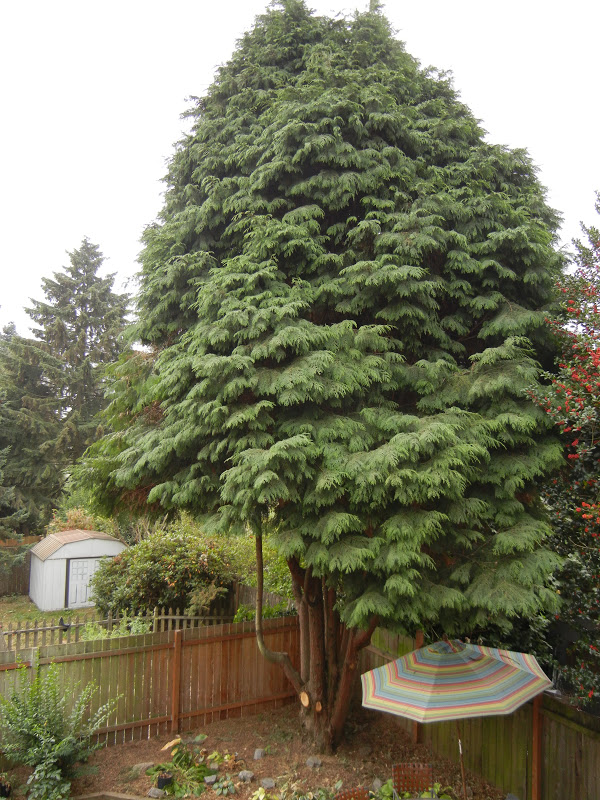
The back yard cedar tree with it's new haircut. You couldn't see my neighbor's garden shed
because of the all cedar's lower branches blocked out sunlight, and the view.
Archie and Bit are becoming closer. Most of the time, when they are not sleeping, they are chasing each other all throughout the house. They provide endless entertainment. Like Beau, Archie's cuteness makes him a magnet for people who wonder what his breed is, and when I tell them Dachshund and Sharpei, the laugh at the incongruity of his mix. Here they are on a lazy summer afternoon soaking up late summer rays in front of the kitchen door.
Another quiet moment with Archie and Bit--this time just before lights out!
Chrstine Goerke in the title role of Richard Strauss's Epic opera, ELEKTRA
My good friend, Christine Goerke made a remarkable debut last Saturday night at the Lyric Opera of Chicago in the title role of Strauss' monumental ELEKTRA. On stage for the full amount of the 100-minute work, Christine (who first sang the demanding role in Madrid last October) rocked the house, singing with piercing dramatic acuity while pouring out an avalanche of dramatic soprano tone. She was rewarded with a standing ovation at her first curtain call, and a universally ecstatic critcal reception from the national, local and international critics in attendance. It was a long overdue acknowledgement of a great singer at the peak of her powers and she set the house afire. Here's a promo prepared by the the CLO for YouTube:
http://www.youtube.com/watch?v=dN_qcCXYrFY
I get to see the final performance on the run on October 30th. I've been waiting for years to hear her sing this part. I have separate audio and video performances of her Madrid stint and I think she's the most sensational Elektra that I've heard since Nilsson and the underrated Oliva Stapp sang the role in performances I saw in the 70s. She's singing her first WALKURE Brunnhilde later this year in Berlin, and starts the new year with her first performance of the Dyer's wife in Strauss's DIE FRAU OHNE SCHATTEN in Amsterdam. This is a prelude to her return to the Met in New York in 2014 for the same role. She's also due to sing her first complete Ring cycle over the next few years in Houston. But watch her profile rise in the next few months. With this Chicago success, Christine Goerke now joins the ranks of the best operas singers in the world.
Christine Goerke during one of many highly emotional moments in
Strauss' ELEKTRA at the Chicago Lyric Opera
If Cinderella can have a glass slipper, I think I can have a glass pumpkin!
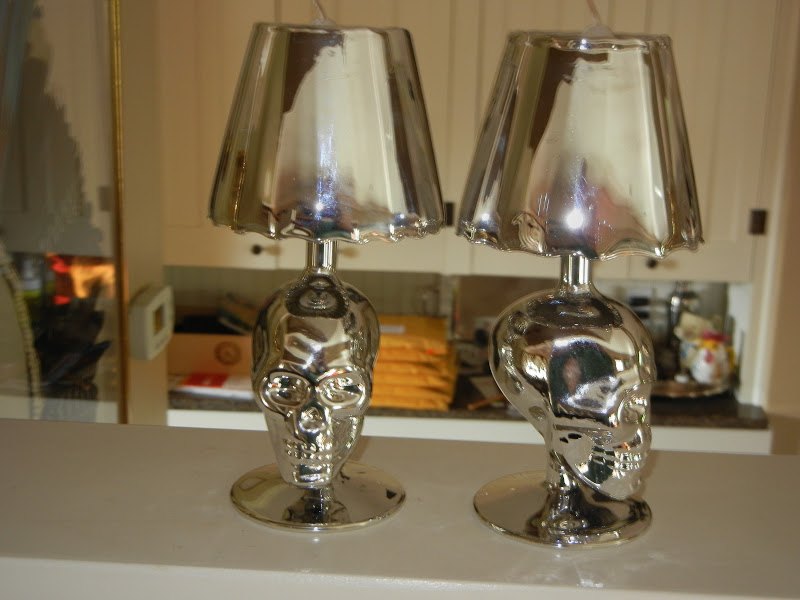
A little ghoulish candlelight for those discerningly formal Halloween sit-down dinners!
Tuesday, September 4, 2012
ARLENE--A CAREER MENTOR HAS DIED
Arlene Friedman and me at a Fawcett sales conference in Scottsdale Arizona, November 1981
I just received the sad news from my friend, Belle Newton, that our former colleague--Arlene Friedman died last Sunday. I had been expecting it. Arlene had barely survived the death of her husband when she learned she had cancer again. She had struggled with this last bout for quite some time.
Arlene Shepherd, which was her married name, and her preferred way of being known since her retirement from publishing, left the business as President and Publisher of Doubleday. She had held previous editorial positions at Macmillan, Crown and Fawcett Books, where she was editor-in-chief when I joined the company. A little background...
After kicking around the publishing business in my youth for some six years, I found myself in January, 1977 starting my career in earnest. I had fooled myself into believing that I should be an editor. Silly me. I had no talent or the attention span required to find and usher a book through the publishing process. It was way too slow a discipline for me. But in 1977 I got an offer to join Fawcett Books, a successful publisher of mass market paperbacks, as a publicist. I had some previous experience having worked as a freelance publicity assistant for a small PR firm that specialized in promoting books. Actually I didn't have all that much experience. I didn't get to pitch authors to TV producers, magazine and newspaper editors. Nor did I get the opportunity to write press releases--the bread and butter of the publicist's daily grind. I mostly stuffed jiffy bags with paperback novels and press kits for mailing, answered the phone, and refereed the growing animosity between my two bosses as their partnership unraveled. But I did pay attention to what was going on, listened to them pitch story ideas to editors and producers, and observed as they created campaigns for their authors. One of their biggest clients was Avon Books, a popular paperback publisher and home to Rosemary Rogers, who was enjoying enormous success as a writer of steamy historical romances--those potboilers that showed a muscled man of action aboard a ship, or standing on the hilltop of his great spread of land, in some sort of absurdly romantic clinch with a woman of heaving bosom and flying red or raven hair. Ms. Rogers popularity was such that she would be sent out to meet her public in various cities all around the country. It was our job to make sure her itinerary was filled with local interviews and events where she would meet her fans and generate lots of sales.
Predictably the partnership of this agency went up in flames one morning. I arrived at the office to find that one of the ladies had actually punched her partner. One of them departed. The other asked me to stay and take on more responsibility at no extra pay. Since she was the person I liked least in the partnership, I decided to leave. A few days later the partner I liked best, called to say there was a job opening in the publicity department of Fawcett Books, one of Avon's chief rival paperback houses. Avon's publicity director had liked me and recommended me for the job. I was sent to interview with Belle, who was the newly promoted publicity director. I liked her immediately. She asked me to write a press release, and gave me a novel by Phyllis Whitney to test my writing skills. I left a little apprehensively. I had never written a press release before. Belle also gave me a few of their press releases to show the department's style.
Fortunately my mother's bookshelves were loaded with many books published by Fawcett: Phyllis Whitney, Victoria Holt and prophetically Anya Seton, a popular novelist of historical fiction. I had read many of them as a teenager. I breezed through the book and then agonized over the construction of the press release. I'm sure were I to read it today, it would embarrass me hugely (fortunately this was the pre-computer era). But eventually I submitted it and waited. I heard nothing. October, November, December all passed by without any word from Belle. I called her in January, intent on demanding the return of my written samples. Belle was very glad to hear from me. Could I come in for one more interview with Leona Nevler, Fawcett's publisher? This seemed to be the break I had been looking for. We set the time and on the appointed day I arrived and was ushered into Leona's large, light-filled office. Her desk was piled high with manuscripts to the point where I couldn't see her behind the precariously stacked debris that threatened to collapse. Leona was a tiny, tightly wound woman with dark hair and sad eyes. She came around to the front of my desk and shook my hand wanly and offered me one of the two seats. Taking the other chair, she asked me why I wanted the job. To this day, I don't understand how I managed to respond the way I did, which went something like this: "I've read James Michener and Victoria Holt from my mother's library. I'm more than familiar with the works of Phyllis Whitney, Taylor Caldwell and Mary Stewart. But most of all Katherine (written by Anya Seton) was one of my favorite books as a teenager (it truly was). I'd like to work for the publisher of all these wonderful books." Leona's eyes lit up. Right away I knew she would always be a supportive colleague if I was lucky enough to land this position. She thanked me for coming and by the time I had ambled back to Belle's office, I had a job.
Those first few months at Fawcett were hell. I was anxious that I would be discovered as a fraud with no talent for publicity. The day I started, CBS bought the company (which included a magazine division with Woman's Day as a flagship publication). I spent an awful lot of time in meetings with the editorial group and then with sales. I was handed lots of writing assignments which jangled my already frayed nerves. But Belle was encouraging and after a few months I discovered I truly did have an aptitude for the job. It suited my short attention-span well. I could interact with every department in the company from production and art departm to permissions. I enjoyed talking with TV producers, travel agents, magazine and newspaper editors, and most of all to the authors themselves. It was also the first time I realized that I could write competently, my publishing future seemed settled, and I was no longer some one's assistant.
Most of these meetings were dominated by a flame-haired woman of generous proportions named Arlene Friedman. She was the editor-in-chief and was possessed of a huge personality. Diane von Furstenberg's famous wrap dress was all the rage in those days, and Arlene owned a closet-full of them. She was the first female executive in clubby publishing world that I can remember who dressed flamboyantly. She even wore open-toed high heels. Her nails were always bright red and her hair was always BIG! I would later discover the technique she used to make her hair look so voluminous. Before leaving her office, Arlene would bend over in her chair and brush her hair forward--at least ten strokes. She would flip her head back, look at the make-up mirror she always kept at her desk and then spray her hair into place. That red hair of hers had a life of its own. In that first year, I got to know Arlene very well. She seemed to like me and I certainly liked her. She was down-to-earth, salty, loved a lewd joke, and spent a lot of time on the phone talking in her high pitched and nasal voice with hardcover editors and sub-rights people and agents, who were her pipeline to finding the best and most successful books for reprinting in paperback. People liked Arlene--a lot. You would go to lunch with her and find that her relationships with these people had gone on for years.
Arlene had worked at William Morris after she graduated from Katherine Gibbs School where she learned shorthand and typing. She did not go to college. She joined Fawcett about twelve years before I got there, beginning as Leona's assistant. Arlene's other skill was that she was a passionate and quick reader. She simply gobbled up book after book. Her reading was prodigious. She would read anything--potboilers, thrillers, literary fiction, crime, romances (historical, contemporary, romantic suspense), tons of non-fiction from politics and biography to how-to, true crime, exposes, and cookbooks. Arlene had an infallible sense a book's commercial viability. She could also negotiate and because of her skills, she was promoted over and over again, finally achieving the title of editor-in-chief.
Arlene's opinion and judgement were front and center of every meeting. She projected confidence and knowledge. She was always prepared. She didn't mince words, and she was impatient with people who wasted her time. She could keep a meeting focused and where others could get side-tracked, Arlene had her eye on the ball and moved it along. Initially she got on well with the CBS executives, even the less-than-experienced management the company installed to run the publisher. Leona would be stubbornly resistant, but Arlene was a negotiator and could almost always work around her bosses. She smiled, kept it civil and business-like and then when it was time to relax, she could be the heart of the party--and it worked for a long time.
I got myself into trouble with Arlene once. We were in a promotion meeting and one of the sales reps was being difficult about the ambitious sales goals of a first-time author's historical romance Leona and Arlene were high on. The book was called THE FRENCH PASSION. Don't know why I remember this title after all these years. I had read the manuscript the night before and was quite taken with it. The sales rep said this particular category didn't work in his territory, and didn't agree with any of the promotion plans set forth. He also hadn't read the book, and despite every one's enthusiasm, still resisted. I piped up without thinking that perhaps I should read it to him, if necessary, and then he might see what all the enthusiasm was about.
A few hours later, Arlene's assistant called me and said Arlene needed to see me. I grabbed a cigarette (we smoked in those days) and headed over to what I thought would be one of our regular cozy chats. I should have known something was up when Aileen, pointed me over to Arlene's desk and told me to sit while she was winding up a call. Then she left and closed the door behind her. WhenArlene hung up the phone, she lit into me in her most imperious tone. " Greg--if you ever do something like that in a meeting again, I promised to embarrass you in front of the entire group. What the hell were you thinking about? Your comment to that sales rep was counter productive, and absurd. Don't ever do that again. Now get out of here, I'm busy." At first I went completely white and then my face turned absolutely fire-engine red. I was mortified. Of course she was right and I felt the complete fool. I fled back to my office and finally took a breath and calmed down. Arlene never mentioned the incident again, and I made sure I never caused her to be that upset with me again. Unlike many others I've encountered throughout my business life, you always knew where you stood with Arlene. There was never any subterfuge. She called it as she saw it. The next day, she was back to her old sassy self, the previous day's unpleasantness forgotten.
We once had to meet with Pierre Franey, the famous French chef to discuss the promotion of his book, The 60-Minute Gourmet. Pierre decided we would lunch at the very fashionable (at the time) Le Cirque (where he had been co-founding chef). Three of us were attending from the publisher and as we looked over the menu, Arlene whispered to me, "what's Poussin?" "Fish," I incorrectly replied with my bad high school French. She was surprised, but I think relieved when a grilled baby chicken arrived on her plate. We had a good laugh about it in the taxi going back to the office.
My favorite memories of Arlene were at the annual American Booksellers Convention or at sales conferences. I was always kept busy at these conventions, planning parties, dinners, lunches, author signings, and various public relations duties. On free nights, we would go a terrific restaurant where Arlene would be at her most relaxed. She loved to dance in those days, and she was an outrageous gossip. She knew about every body's business. She was never mean or cruel about someone unless they were truly awful. She was a favorite of every hardcover house's sub-rights director--the folks charged with selling her the paperback rights to their top-selling books. In addition to all the bestselling romance fiction, Fawcett also published other big-name authors: John Updike, Art Buchwald, Thomas Tryon, John D. MacDonald, Jeffrey Archer, Charles Schultz, and many others. At these industry gatherings, Arlene was good company. She'd glad-hand anyone who came up to say hello. Her generous spirit insured that anyone around her would have a good time.
I've written before about Arlene's long marriage to Harold Shepherd. I often had dinner with them, and during the holidays, I always joined them for their annual Christmas Day party, where I usually supplied dessert. One year Arlene, who was a pretty good cook, was upset about a chocolate dessert she had made. It had been in the oven for far longer than the recipe indicated and she couldn't figure out why it seemed so under-done. She called ahead to warn me there might be a problem and then read me the recipe. Nothing seemed out of order and when I arrived, she pulled it out of the refrigerator. I asked to see the recipe again. Still nothing seemed amiss. For some reason, I asked her how much heavy cream she had used. A light bulb went off in her head as she showed me the container. She had used a whole pint rather than the eight ounces the recipe called for. The cake managed to hold together, but it was fragile looking. I helped her cut it in the kitchen before bringing the plates out to guests at the table. Of course it was delicious and following Julia Child's maxim of never explain, never complain, we never acknowledged the error. Nobody was the wiser.
Arlene and I worked together for five and a half years. But the paperback industry was already having troubles, and CBS was not happy with the company's financial performance. The last year was very tough, with Leona being sacked because she had resisted every change the corporation tried to impose on us. Arlene took over Leona's responsibilities, and she found herself depressed that this happy career she had so long enjoyed was falling apart. I had become publicity director by then, but it was clear our days were numbered. CBS eventually sold Fawcett to Ballantine Books. Most of the staff didn't join the new company (ironically Leona would end her publishing days at Fawcett, Ballantine having re-hired her). Arlene and I were given our departure dates. Betty Prashker, an old publishing friend, asked her to join the team at Crown Books where she got me involved in a bad plan to have Outlet, a Crown subsidiary that specialized in remainders and reprints of older picture books and reference, join in a partnership with Waldenbooks (the forerunner of Borders) for a line of paperback originals called Pageant. It was doomed from the beginning, but it did give me a chance to work with Arlene again, if only for a little while. Eventually Arlene decamped for the chance to run the Literary Guild in its last profitable years. She ended her career as president of Doubleday before retiring. Quite a resume for a lady who had gone no further in her education than secretarial school. I wound up at Wm. Morrow before leaving the corporate publishing world three years later to go out on my own as a freelancer.
We stayed in touch, though not as often as we used to. Arlene kept herself busy between homes in Manhattan and East Hampton, where her husband owned a very successful real estate business. She kept up her reading, gobbling up books faster than anyone I knew could possibly read. She was also a huge movie fan, and could be seen at screenings of new movies all over town. When I decided to move to Portland, Oregon in 2009, one of the last lunches I had in Manhattan was with Arlene and Belle. Arlene looked ill. She was moving slowly, though she was immaculately groomed, her red hair still a thing of wonder, her nails a gleaming red. She still had that naughty glint in her eye, but she also looked sad. Shep was failing--both had been dealing with illness. We stayed in touch and I often sent her jokes, links to my blog about life here, and the occasional phone call. I wrote her a very nice note of remembrance when Shep died, and she called to say how touched she was. In the last year or so, she would send a note telling me she was hoping to come out to Portland for a visit. That would have been something to anticipate. I would have loved squiring my mentor around town, showing her the beauties of Portland, and taking her to some of our fine restaurants.
Arlene will be mourned and missed by her many friends and colleagues in the publishing business. She came of age when books still meant something as a cultural entity--as important as movies or television. At the peak of the mass market paperback business, millions of copies of a popular novel were routinely published in paperback, and many of them back listed for years and years. Today the escalating cost of the average paperback is too expensive. People can download books on their tablets and e-readers. The Internet has cut into the time people used for reading (such as this blog). I know it sounds hopelessly old-school, but in Arlene's era, there were big personalities in the publishing world and it was a smaller universe, most of it concentrated in New York. It was easy to know everybody and Arlene Friedman made it her business to do just that.
Arlene was a good colleague, mentor and friend. She was a kick to know--memorable in every way and I will miss her terribly.
Sunday, September 2, 2012
OREGON STATE FAIR
Two rather large pigs NOT doing what you think they are doing!
A black cow being readied for display. This was had the shiniest coat, and when I petted her, I understood why. She had been given a coat of some sort of oil to give her a shine.
Two very sweet Nubian goats. If I had my druthers, I'd raise a goat in my back yard. Very gentle creatures.
A very large boar prancing around the judges. He was huge!
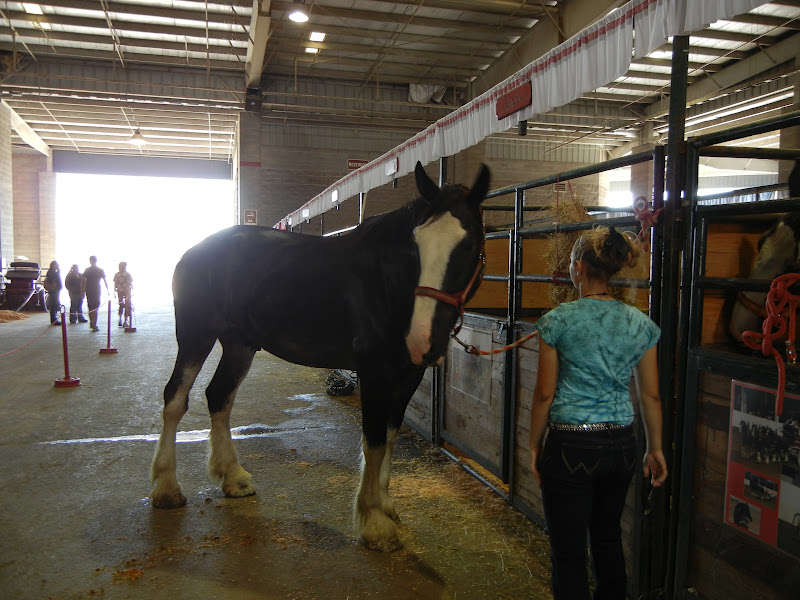
Meet Bubba, a friendly Clydesdale. This horse was very tall and beautifully proportioned.
As a young teenager, I have fond memories of going to the Sacramento State Fair with a friend of my family. Si would gather his daughter-in-law, Shirley, and her two children, and me and my three brothers, and head north from San Francisco to Sacramento. Si would happily spend the day at the racetrack, away from his nagging wife who was always on him about gambling, while Shirley and I would ride herd on the kids, taking them on all the rides, visiting in the livestock, admiring the 4-H exhibits and drooling over the ribbon-winning cakes, breads, jams, and pickles. We would plow through the honkey-tonk of all those carney games of chance and skill--skeet ball, tossing a ball at a tower of faux-milk bottles, sinking basketballs in a net with the prize being a junky stuffed toy you'd be embarrassed to give your friend's kid. We would meet Si in time for the last race, then drive back, stopping in Santa Rosa for a swell dinner. It was just the kind of family outings we so rarely did as kids, and it left an enduring impression.
Forty-some years later, The Oregon State Fair is just winding up it's annual two-week stint in Salem, and I talked my friend, John Baker into a visit. He'd never been to a state fair before. We chose Friday feeling there might be less people to encounter over the busy Labor Day weekend. Good decision. We drove down to Salem around 9:30 am and arrived at the fair an hour later. It was still cool under a blue, cloudless sky and didn't get any higher than comfortable for the five hours we were there.
The variety of the goat's coats was fascinating. These gentle creatures are curious an friendly.
I want to make a home for her in my back yard. I wonder what Archie would think of her?
These two seemed very adept at posing for the camera
The first stop was to check out the animals--cows, pigs, sheep, goats, rabbits, chickens, guinea pigs. Row upon row of these creatures, most of them seemed happy to be well-fed, well-groomed and well-loved. Mostly tended to by teenagers, we'd get into a leisurely talk with a young man or woman and it was wonderful how well informed they were about their ranching lives. They could answer just about anything you could think of about the animal's well-being. I was astounded at the range of chickens, goats and rabbits. The goats were particularly fun to be around, especially a long-eared breed called Nubian.
This rooster had magnificent coloring on his feathers
I tried, but this magnificently plumed rooster resisted my every effort to get him to pose
This is the evil ride that John talked me into. My stomach was turned inside out.
After more than an hour with livestock, we headed over to the carney section of the fair. So many silly games of chance and skill to separate you from your money. I won't play because the prizes are so awful--mostly stuffed toys in garish colors. Or a plastic, air filled hammer, or some other junky nonsense. We didn't spend much time there for rides were on our minds. I wanted to do the Ferris Wheel and bumper cars. We did the Ferris Wheel (at a steep $4.50 for about five complete turns!). The average age of the kids on the bumper cars was about six, so I changed my mind. John got an evil glint in his eye and suggested this insane ride. A large merry-go-round-type of ride with swing-seats attached to chains that go up to the ceiling. You are locked into one of these seats and it raises and begins to spin, gathering speed. Suddenly you are thrown out sideways in circle after blurry circle of of spins while your chair whooshes and your turn and dip in a stomach-churning rotation that left me very queasy. I was grateful when it ended. And by the way, it cost $4.50 for that nausea-inducing ride!
The views from the relative calm of the far more civilized Ferris Wheel, were enjoyable instead the
blur as seen from the precarious seat of the above mentioned ride.
We went in search of a snack. John chose something called an elephant ear--a large, flat, fried piece of dough with cinnamon sugar sprinkled with a heavy hand as it cools--$5. It couldn't have cost 30 cents to make. I had forgotten State Fairs are a legal way of separating you from your money. We walked through a garden, which was a riot of color, especially the lowly coleus plant that has the most spectacular display of colored leaves. We walked through an artist gallery of pottery, jewelry, carved wood, and other crafts. I found a lovely wind chime of vertigreed copper with a humming bird. We stumbled upon an outdoor wine shop, where we tasted a pretty good glass of domestic Oregon rose made from Spanish Temperanillo grapes. Most domestic rose is a bit too sweet, lacking that crisp and lean taste of the more famous Provencal rose. We sat at a shady table and just enjoyed the day as we sipped out wine.
The quilt-maker's art as stunningly realized here. How I would love to own this.
We then went to see crafts that were judged at the Fair. I wasn't too impressed with the cakes and breads that were on display. The cakes in particular lacked imagination and some looked like bad entries in a Food Channel cake-baking competition. I was more interested in hooked rugs, and the quilts. Here are two spectacular hand-made quilts that have nothing to do with grandma's handiwork. These were sophisticated examples that begged to be hung on display in a family room.
Or this subtle beauty. Can you imagine the hours spent creating this masterful quilt?
It was time to take a look at the 4-H entries. I'm always astonished at the talent of young people. The art and photography exhibit was prodigious in its entrants. Who knew kids could have such compositional eyes at this tender young age. The baked goods were far more impressive than the adult entries. As we moved our way through the exhibit, you couldn't fail to not be impressed with the science projects, books, furniture, sewing samples, and other craft work on display. Made me wonder why more kids aren't raised on farms.
The only low-point was a large area devoted to modern amenities and products such as mattresses, hoses, mops, cleaning products, cookware and other house-hold products. What made it unpleasant was the sight of a George Romney for President recruitment booth, and right next to it, some "right-to-life" booth with plastic representations of fetus' at various stages of growth. It was offensive and out-of-place in a state fair, which should not be used for making political statements. But I forget it is Salem, Oregon, which is not only the state capital, but a hotbed of Republican thinking. In fact most of the state is very, very conservative, and were it not for more left-leaning Ashland, the college towns of Eugene and Corvallis, and the big-city progressive-thinking Portland, Oregon would be a tea party state, through and through. I forget we live in a bubble here in Portland.
The ponies are well-cared for and very shy.
Our final destination was the horses. We had seen a few Clydesdales in the morning, but there were ponies, an quarter horses to view. We got to a competition area where we admired Clydesdales in surreys, looking resplendent in their finery. Most were black or dark brown but I found one tan Clydesdale who stood out from the pack. The ponies were adorable, and I might have tried to get a ride on a pony-riding group, but I feared my weight would be onerous.
Coleus in all their summer glory
The Oregon State Fair is smaller than its California counterpart. I wish in a state that prides itself on the quality of its food, there had been more representative vegetables on display or a more creative way to showcase them other than behind hot display cases that made everything look a bit wilted. Vegetables were particularly affected with wrinkled skins. Why isn't there a farmers market attached where people could bring home the bounty of the canner's art such as preserves and jellies, pickles and other vegetables, whole fruits in syrup? With all this baking, why not carry home a pie or a fine loaf of bread? Or a bucket of peaches? Isn't there a way to gently combine commerce and state pride, reduce the number of junk food stands and sell real food?
Even without a racetrack, it was wonderful to see kids engaged with their animals, which to me, is the highlight of any state fair. The livestock just fascinate and captivate people. They linger to pet a gentle lamb or giggle at either the laziness or rambunctious activities of the pigs. Best of all, the Fair mostly met the nostalgic pictures in my head from my youth. I won't do it every year, but if you haven't taken in a state fair, it's a very pleasant way to spend a few hours on a lazy summer weekday.
Two teenagers grooming a lamb
No this isn't Uncle Barney's abandoned toupee--it's a Guinea Pig!
Subscribe to:
Comments (Atom)