Monday, April 30, 2012

SANDWICH NIRVANA


East Moreland Market & Kitchen serving some of the best sandwiches in Portland 
(or anywhere else for that matter)

In the last few weeks, I've rediscovered a fabulous small market, tucked away on a quiet residential street in the heart of the East Moreland neighborhood in South East Portland. They serve the most wonderful sandwiches at lunchtime, and they are so good that it got me to thinking about sandwiches, one of my favorite food categories. I started thinking about some of the memorable sandwiches I've ever eaten from my travels and the cities I've spent a lot of time in.  So forgive my long and obsessive recollections of sandwiches. And if you're in the vicinity of one of Portland prettiest neighborhoods, you owe it to yourself to come to this friendly and quaint market to buy groceries, wines, meats or have a cup of coffee, or a glass of wine. But don't forget to treat yourself to one of their many incredible sandwiches.  You'll go back again and again and again. 

The sandwich has alway been a marvelous invention.  But they need to be carefully made.  A heavy hand can turn a meatball sub into an acid-reflux nightmare. Everyone has their own personal likes and dislikes.  Relish in tuna salad, for instance, makes me violent. I have memories of sandwiches that stretch back to my childhood. We never ate ham, salami, roast beef or turkey sandwiches until my brothers and I were well into our teens. Peanut butter and jelly, tuna salad and bologna were my daily lunch fare. The minute I had a job selling flowers all over San Francisco where I grew up and earned my own money and independence, I began to assert my own adventurous sandwich palate.

There was a small supermarket with a butcher across the street from our home in the Sunset district.  The butcher roasted chickens and turkeys and also had cold cuts that I loved, particularly Italian salami, which I had them pile high on sour dough rolls with provolone or swiss cheese, yellow mustard (hadn't been exposed to Dijon yet) and shredded lettuce.  They were addictive. My twin brother dated a young girl whose parents had a small, but very nice breakfast and luncheon shop in the main business area of the Mission district, right near the flower show where we bought our roses. They made a grilled tuna and Swiss cheese combination that was as close to a perfect sandwich as I ever got. The rye was grilled with butter to a golden hue, and stuffed with tuna and Swiss that melted. Served with coleslaw and a dill pickle, it was my go-to sandwich from that neighborhood.


Muffuletta:  Layer upon layer ham, salumi, mortadella, swiss and provolone.Topped with special 
house made pickled vegetable, olive salad, on ciabatta

San Francisco in the 60s had many German-style "hoffbrau" restaurants that specialized in steam table cooked foods. Not much in these popular restaurants interested me except their sandwiches. There was roast beef, or turkey or corned beef, sliced to order and piled high on rye bread or your roll of choice with mustard or mayonnaise or both.  Roast beef sandwiches were served on rolls dipped in a beefy, fatty and thin broth called a French dip. While I enjoyed them on occasion they were the precursors of  the kind of overstuffed deli sandwiches served regularly at the Carnegie or Stage Door delicatessens.  Awkward to hold an a mess to eat, they were never really my cup of tea.

Two more San Francisco sandwiches are remembered from my youth:  I recall a tiny, crazy busy financial district takeout shop where I would often meet my mother or friends, order a sandwich and sit in the park for lunch, weather permitting. It was called Paoli's and sandwich I remember was a rich egg salad with a thick layer of minced black "California" olives served on a dark pumpernickel bread. It was a spectacular sandwich, filled without the contents falling all over you as you continued to chew your way through it. The egg salad only had mayonnaise, but it was balanced and the saltiness of the olives complimented the bland richness of the egg salad. My final sandwich memory is of course, Mel's Diner. When I was a teenager, I hung out a lot at Mel's on Mission Street near Vaness Avenue. That was the era of car hop waitresses who roller-skated to cars parked outside the restaurant and served people burgers, fries, Cokes, milkshakes, and other drive-in fare. The place was packed with cars and those girls, who were pretty, sassy and could handle themselves whenever a car diner got frisky, worked really hard to please their hungry clientele. The later it got the busier Mel's became.  George Lucas would make Mel's iconic in his film, American Grafitti.  Mel's served an original creation, the Patty Melt, a hamburger patty, pressed thin and grilled, served on buttered rye bread with American cheese and grilled onions. It was easier to eat than a hamburger and didn't come with lettuce and tomatoes to interfere with it's beefy-cheesey goodness. For a time it became another sandwich obsession of mine.


Chef Jesse's Mushroom-Bacon Burger at East Moreland Market & Kitchen

Over the years, I refined the qualities that appeal to me in sandwiches.  I've never lost my affection for tuna salad. It will always be a favorite. But I prefer my tuna packed in oil rather than in water, which is too bland.  I don't eat much salami anymore, not because I don't like it.  I have these arbitrary rules that forbids me to eat salami or hamburgers most of the time because they are full of fat. Doesn't make a bit of sense, because my other choices are equally high in fat content. Other sandwich no-nos include those famous deli towers sold at Carnegie Deli and Stage Door. I don't like sandwiches that are bigger than my mouth. I don't like meat juice and fat running down my arms. I like a sandwich to be easyish to eat. Cheese is almost always a necessity on my sandwiches, unless it is peanut butter and jam (never jelly).   I rarely like butter on a sandwich, unless it's hot. My grandmother used to put butter on bread before she added ham, which I think is disgusting unless you grill it. I love ham. Most turkey is awful, either fresh or deli-sliced. Packed with water, most deli turkey may be lower in calories than other deli meats, but it is also tasteless, especially the supermarket kind. I'd rather eat leftover steak on a sandwich rather than thinly sliced deli roast beef. I love ham, especially Boar's Head deluxe ham, which seems to strike an ideal balance of sweet and salty.

In New York, one can find some perfectly awful sandwiches. Most tuna salad there doesn't come close to the quality I grew up with. Your average burger is shockingly bad and carelessly made when compared to the consistently excellent versions commonly served in Portland. Good restaurants are quite capable of producing excellent sandwiches, such as a memorable Lobster roll at Cafe Luxembourg, offered as a special for $25 in 2005. Another spectacular sandwich was a whole soft shell crab, dredged in flour and sauteed until crisp and served on a ciabatta roll with arugula, sliced tomato (a brilliant red, in-season tomato), and house-made tarter sauce at a popular Pearl Oyster Bar in the west Village.

Rome is a very nice place for a sandwich. You can go old school and get a loaf of bread, some salami and cheese, a bottle of wine and a friend and sit in one of the piazzas and enjoy people watching. Romans often stand in little cafes, and eat their sandwiches, that have been prepared in the standard, old-school way:  three slices of thin white bread with a variety of fillings (ham, prosciutto, tuna or egg salad, cheese, slices of cucumber on one layer or marinated red pepper strips).  Some have anchovies. All are cut into elegant triangles. Pretty and tasty, these are sandwiches you'd be proud to treat your Aunt Mildred to. On my very first visit to Rome, I walked into a place I would describe as a high end Italian deli. There were prosciutto's hanging overhead. Counter were loaded with all sorts food stuffs with cases of cheese, or salumi, or little balls of cooked spinach that had been squeezed dry and could be brought home and quickly warmed or sauteed for dinner that night. The place was mobbed with shoppers and I was overwhelmed by the good looking food, the handsome packaging, the yelling servers, and the slow milling of a hungry and packed crowd. Suddenly I was pushed over to a counter of rectangular pizzas just out of the oven. I watched as customers signed how much pizza they wanted and quickly figuered out that you paid by the slice and the size of the slice. And then I saw it. A golden and crusty potato pizza sliced with olive oil and rosemary. The aroma was sensational. I motioned to the clerk and he gestured back to me:  how much do you want? With two fingers, I indicated the generous width I was looking for.  He cut the slice and then folded it in half, the potato insides facing each other. He then wrapped a piece of brown paper around the bottom of the folded middle and handed it to me, gesturing to where I would pay for it. I started to eat it even before I paid. A pizza slice is not a sandwich you say? Well folded in half into itself would certainly qualify for sandwich status in my book:  two crusts on the outside with the potato in the middle as filler.  Sandwich indeed. That insanely good pizza sandwich was a highlight of that trip. I remember going back to the neighborhood to find that shop again, which I inexplicably forgot to notate. I have retraced my steps in that neighborhood on many subsequent visits to Rome and have never found that shop.  That potato pizza will haunt me for the rest of my life.

A word or two about bread. My choices are sliced sour dough, rye, pumpernickel, and whole wheat, and I've pretty much given up on eating sandwiches on rolls, though ciabatta are a good solution, and I now understand why you see people slicing rolls or Italian or French bread and pull the insides of the bread out in the preparation of the sandwich. Otherwise everything falls out of them.  I never put slices of avocado on a sandwich for this reason. Mashed avocado at least stays put. Slices of avocado, even bread tend to slip out of the sides. I've become rather fond of wraps, though it is shocking how so many bad sandwiches are made with them.  Tortillas are great, and I often stuff them with leftovers for lunch, or warm for breakfast with scrambled eggs, bacon and cheese. In fact a bacon, egg, and cheese sandwich on a soft, toasted Kaiser roll is a little bit of heaven to me--please don't pass the ketchup bottle. Scrambled eggs with bloody splotches of ketchup are on my disgusting list too.

Hamburgers--I ate a ton of them when I was in my 20s, not so much before that, and before moving to Portland, barely touched them in my 30s and 40s. Portland is a city of burgers, as I discovered when I moved here in 2009. The quality of the beef that is found in hamburgers here is very high.  Still all those things they pile on hamburgers just get in the way and make them a mess to eat. Tomatoes should be banned in any sandwich, they are almost always tasteless out of season.  Besides ketchup takes care of the tomato flavor.  Cheese and bacon add to the fat content, but are really nice additions. I don't care if it is American, cheddar, Swiss, or blue cheese. Pickles are a nice edition and with lettuce, some mayo and, you've got a complete burger. No mustard, please. That's for hot dogs, which I prefer with sweet pickle relish. Raw onion disagrees with my system, though I often risk heartburn with a thin slice of red. Foster Burger, the brainchild of Pol-Pok's resident genius, Andy Ricker and Daniel Mondok (chef of the late, lamented Sel Gris) pooled their resources and opened a funky joint in a semi-tawdry area of industrial SE Foster Blvd. They were a hit the second they opened their doors and for good reason. The Foster burger just may be the best burger I ever ate. Beefy and tender, cooked to your order (though apparently rare is against the law here), the burger is served on a delicious semi-soft bun of quality. They smear the buns with their own sauce, lettuce, pickle. It comes with the excellent house fries.  Foster Burger has maintained its quality, even though Ricker and Mondok have moved on.  Portland is rather proud of the quality of its burgers, and it is the rare restaurant that doesn't off their own take on this sandwich classic. Gruner, Chris Israel's special take on "Alpine Cuisine," (hardly what you would think of as a place for a hamburger) has an especially well regarded burger on its bar menu).

Without a doubt, the banh mi sandwich is the biggest discovery in the sandwich world since the creation of the Big Mac. This hybrid is from the era when France ruled Vietnam, and is a French roll stuffed with a combination of meats and vegetables, such as pork or pate or chicken, or beef with shredded carrots, hot peppers, daikon, and cilantro. In New York the banh mi can be very elaborate with crusty French baguette, duck, and other exotic ingredients. Here in Portland, the French Baguette shop is a Vietnamese bakery that specializes in delicious, inexpensive banh mi which keeps the two locations hopping.  My favorite holds grilled pork, and all the veggies listed above. I add a liberal squeeze of Sriracha sauce for some extra fire. The average price for one of these fantastic creations is about $3!


Grilled Cheese is only the beginning of this beauty. There's a fried egg in there, baby arugula and pancetta as well. 

Bunk is Portland's current favorite sandwich joint famous for its pork belly and meatball heros. But
recently I have found sandwich nirvana at the East Moreland Market and Kitchen. Reminding me of the small grocery market across the street from my house as a teenager, the owners (former restaurateurs) found this empty space in one of the poshest neighborhoods in Portland. The store specializes in ingredients from Spain and Italy, which means you can find all the authentic ingredients you would want to cook these cuisines. The shop has a frozen section, a fresh organic vegetable area, a butcher, offering beef, chickens, pork and house-made sausages as well as  high quality charcuterie. You can purchase excellent breads and bakery desserts. But it is the freshly made sandwiches, artfully prepared by chef Jesse, that have caught my attention.  I'm not a fan of the Rueben sandwich--there are too many terrible versions in New York.  But East Moreland's Rueben is beyond nirvana. They slice Grand Central Bakery country rye and toast it. slathered with their house-made dressing, then stuff it with very thin slices of corned beef and house-made pickle slaw. I could eat this once a week. The ingredients, the bread, and the dressing made me forget about the grilled, greasy messes I've sampled in the past.

The first sandwich I tried here was something called the Rudy. Here's how it's described:  Bocadillo de calamari. Fried calamari on a baguette with jamon serrano, manchego cheese, arugula and spicy aioli. The calamari rings are dredged in flour, smoked paprika, salt and pepper and quickly deep fried. They keep the coating very thin, so you taste the squid. The result is a salty, tangy, combination with the manchego, baby arugula, and serrano ham within the confines of an elegant, crunchy baguette . My first bite into this superb combination sent me into orbit. I often ate a Cubano at a terrific little Dominican hole-in-the-wall near my last office in New York. A Cubano is a pretty difficult sandwich to screw up. East Moreland's version is a little more elaborate than your average Cubano:  house- roasted Tails and Trotter pork with mama lil peppers, pepperoncini’s, pickles and yellow mustard on ciabatta, pressed. There is a thrill in every tasty bite of this outstanding version.  The Grilled Cheese is somewhat misleading: gruyere and muenster are joined by a fried egg, some crispy pancetta and baby arugula on a toasted brioche roll.  I would call this the ultimate breakfast sandwich, but I keep wanting it for lunch. There are more choices to keep me coming back, such as their mushroom bacon burger, which  a friend recently tried an deemed very special.  I've made friends with the owner and chef and we talk food, cookbooks, the neighborhood.  


The very pleasant cafe interior of the Eastmoreland Market and Kitchen 

3616 Southeast Knapp Street  Portland, OR 97202
(503) 771-1186


Sunday, April 29, 2012

SPRING PHOTO UPDATE


Double daffodils from that pot of bulbs that were never planted in soil!


Gorgeous!

I went to Amazon and typed in THE OREGONIAN COOKBOOK, and it took me to the book!  I was so excited to see some tangible proof that the book is a reality, and I'll the first copy in my hands in a little more than four months. That time flies, as I've recently realized while watching my friend John Baker, race towards his retirement date of June 1. As we age, the time seems to accelerate rather than slow down.  But that's another issue entirely.


Coleus clippings in water to root. These and another variety will be filing my balcony 
planter boxes this summer.

The grass was so high in the backyard, I doubted I could mow it down to a manageable length. Fortunately, a guy showed up in my front yard with a bicycle and a lawn mower. He offered a great price and within 30 minutes, the grass was neatly a lawn again. I really don't like having any lawn in my backyard. I'd prefer a lot of containers surrounding three trees I've planted in the grass off the brick patio and the rest to be pebbles. Beau needs a place to do his business, but that could be under the big cedar tree or behind the garage.  I just started the process of rooting my coleus which have been growing and getting leggy inside. They will be my balcony planter box fillers this summer. Coleus love the hot summer days and under the sun, their colors intensify and bloom. I haven't started my vegetable garden, and I'm going to have to get top soil and mushroom compost this week now that the weather has stabilized and start buying small herb plants, cherry tomatoes, some peppers, whatever else strikes me as worth growing this season, and get going with my summer garden. Some more things are growing, blooming and definitely anticipating the summer season. 


My vibernum shrub in its second season.

A block away and across the street is a large house and lot hidden by a large and private fence. The woman who owns the property calls it an urban farm, and indeed it is. She sells pots of plants and flowers, some vegetables, and raises gorgeous chickens.  She also makes cement bird baths in the shape of leaves that she paints in beautiful metallic covers (I have one) and path stones for the garden.  Last summer I bought a vibernum shrub, with round pom-pom-shaped flowers that resemble miniature hydrangea, and it is planted in a large pot that lines the slate walkway to the front door of my house. Right now, my vinbernum is all in bloom, but the flowers are a pale green now.  In a week or so, they will be pure white.  My farmer neighbor has an enormous vibernum that towers over her fence, and I took this photo.  The property is set up high and when you enter the front gate, The cement wall is below the fence is waist high, and she has planted these flowering plants that hang along that wall and in the spring is an eye-catching white and yellow riot of blooms. It turns green after the spring season. But I always walk past to admire it in spring.  

 
My farmer neighbor's outside fence all dressed for spring. 


Another type of vibernum.

Trying to eat more fish and this week found some Alaska cod. I bought a nice fillet and then got home and instead of over-thinking and looking for a recipe, I simply dredged the fillet in some flour and sauteed it quickly on high heat with a little butter and a little extra-virgin olive oil. Some salt and pepper, a sprinkling of chopped parsley and a squeeze of lemon. The fish was superb, mild and delicious with just the simplest of ingredients that let the fish shine. I had a small butternut squash and thought of a great Jamie Oliver recipe for it. You peel and cut the squash and toss the pieces in extra-virgin olive oil, crushed coriander seeds, red pepper flakes, fresh thyme leaves, and bake under a wet sheet of waxed paper for about 25 minutes. I had some left-over creme fraiche instead of whipping cream and mixed that with a quarter cup of a dry French rose, and tossed it over the squash with some parmesan and baked it another ten minutes. One of Jamie Oliver's very best recipes! The night before, I cooked a recipe from Mark Bittman's HOW TO COOK EVERYTHING: The Basics. It's a new how-to by the author of the current best all-purpose cookbook (HOW TO COOK EVERYTHING), only this new edition concentrate of a number of basic recipes profusely illustrated by excellent photos. I stumbled across a braise of cabbage with a Asian slant composed of shredded cabbage, garlic, scallions,  soy sauce, toasted sesame oil and I added some red pepper flakes.  Cabbage isn't high on my list of vegetables only because it's not very versatile. But this hot shredded braise was really delicious and reheated well.  Now that's a nice weeknight meal. Bittman's book is not for my library, though I will retain this dish. But if you're a beginner cook, I do think this book should be essential in your library. 

Saturday, April 7, 2012

CAMELLIAS, SQID & SQUIRRELS


White camellias from my front yard tree

I've had a craving of late for a Basque Squid Stew. It's a recipe from Rick Stein from his two-volume collection on fish cookery:  Fruits of the Sea and Taste of the Sea.  While Portland is very close to the Pacific Ocean, the city has a land-locked mentality when it comes to seafood other than salmon and Dungeness crab.  It's very difficult to find fresh (not previously frozen) seafood of any kind in the local markets here. This stew is a snap to make and has only a few ingredients:  olive oil, squid, onions, garlic, red wine, tomatoes, water, thyme, salt and pepper. You brown the squid rings and tentacles in olive oil first and then add our onion and garlic.  One the onions take on color, you add everything else and turn down the flame to low, cover and simmer gently for two hours until the squid becomes meltingly tender. I serve this over steamed red potatoes. My first stop for fresh fish is Pacific, a fish monger with a good reputation in my own neighborhood. They sell only frozen squid, but recommended that I try ABC, a shop 30 block uptown.  I'm glad I did.  This Asian-owned fish store specializes in crab and they have tanks full of fresh Dungeness crab, all live and very well priced.  They have a reasonable, if limited supply of fish and focus primarily on seasonal fish. They had fresh squid, but they were sold whole. The price per pound was a whoppingly low $2.29! This meant my stew would be dirt cheap, as the original recipe intended, but I would have to clean and prepare it.  I ordered two and a half pounds figuring I'd net out at the needed one and a half pounds. Later, I saw prepared squid at New Seasons, a fine if over-priced local supermarket chain here that specializes in organic and non-organic food, sells previously frozen prepared squid. It's more than $5.00 a pound. But squid, which is cheap and sustainable and is good for you (that is if you don't limit yourself to the popular fried calamari), shrinks when it is cooked, and if frozen, shrinks even more.


I had never prepared cleaned before. A quick look on YouTube gave me a fast if slimy education on the task at hand. I had to cut off the tentacles right in front of the eyes, then squeeze out the mouth (or beak), which was easy enough to do.  The next step was to gently pull the head out of the body sac with all the gruesome entrails attached, then squeeze out the sack to remove all the other disgusting bits. A final removal of the skin (easy) was the final step. It's dreary work, messy and a little stomach-churning. It took an hour, and Bev--my roommate--came into the kitchen while I was elbows-deep in squid entrails and fled in grossed-out terror. I felt a bit squeamish at first, but in the end was proud that I didn't wuss out and the final stew made a great centerpiece to a Friday-night dinner with my friends Trish and David Hamilton, who brought a superb merlot from Owen Roe.


Dirttless daffodils

The endless rain has been a constant companion as we get down to the final elements of THE OREGONIAN COOKBOOK.  So when the sun does peek out, Beau gets restless for the outdoors, and usually find one of the steps with the most sun an ideal place to stretch out for a warm nap. The grass is still squishy wet, but everything is leafing and this week the white Camellia began to bloom in earnest.  I think it's more beautiful than red or pink variations, and I've finally begun to cut some and put them in vases in the house. They are quite beautiful. The daffodil bulbs in the plastic pot that I neglected to plant, have begun to bloom this morning.  My mother absolutely cannot believe I've been able to get them to bloom this way, but I have.  If you look at the pot from overhead, you can see any dirt. Don't know why it worked, but it has.


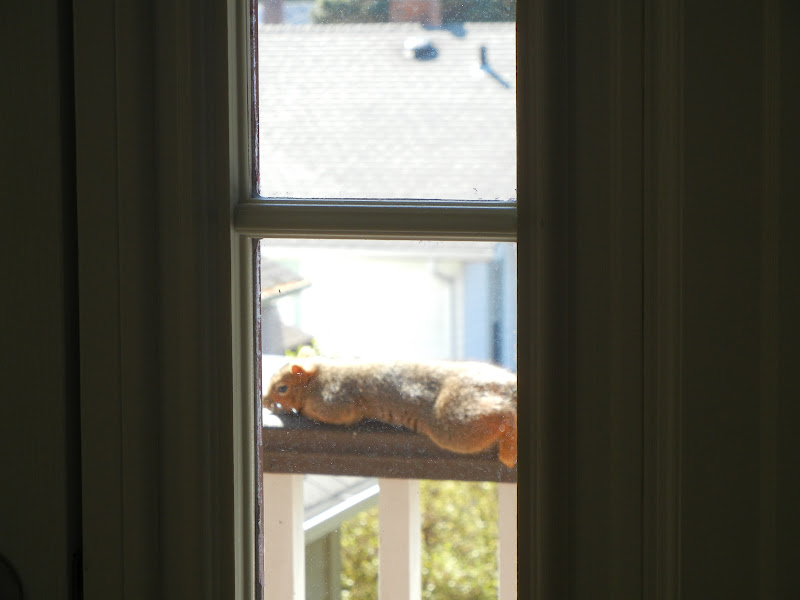
My new resident squirrel, sunbathing

Since Cooper, my back yard squirrel died last year, I haven't seen too many squirrels until about a week ago, when I found a red Fox squirrel sunbathing on the railing of my bedroom balcony.  He was very accommodating while I went to grab my camera and seemed not to be bothered in the least that I was snapping his photo  Then last Saturday, I discovered he has taken up residence in my cedar tree. He's quite bold an unafraid of me, in fact these photos make him look downright curious. I hope he survives. Too many squirrels in this city end up under the wheels of cars. This new tenant is quite handsome with a luxurious tail.


I moved a chair next to one of the windows in the living room. In that window is an "elephant foot" plant, one of my favorites because it sports a bountiful show girl headdress of long leaves which are now reaching below the stand it sits on.  This fascinates Bit, and I caught him trying to chew some of the long tendrils as he played with it the other day.


Bit is enjoying playing with the Elephant plant


The Ornamental Dwarf Cheery Tree in full bloom 


This delicate Fritalaria had me worried it might not come back, but here it is in full bloom, it's purple 
lantern-shaped heads showing off a lizard-like pattern. 


Monday, March 26, 2012

SUNBATHING SQUIRREL/CHOCOLATE TART


Under the heading of "now I've seen everything," let me add a sunbathing squirrel. Coming out of my bathroom, I saw this beautiful little squirrel basking in the rare sunshine of a late March morning. It startled me a bit and I decided to grab my camera and see if he would sit still to some photographs. I got these three shots and then grabbed my roommate to come upstairs and see for herself. The cat was sleeping on the floor right in the front of the glass door to my bedroom balcony. And Beau was sleeping in one of his daybeds in the same room. The squirrel didn't seem to mind a bit.


The way he's lying down reminds me of Beau when he's all stretched out with his hind legs all the way behind him.

Friday, I had the opera gang over for dinner with Carol, Sarah, Lynne, Maureen and Jim, Marie and Justin.  We feasted on Porchetta (a special dry-rubbed shoulder of pork which is tightly wrapped in two thicknesses of foil, and roasted for four hours until it is spoon tender), pressure-cooker risotto, a farro and garbanzo bean salad, and a green salad.  Since I do most of the desserts for our gatherings, Lynne asked me very seriously if I would make something with chocolate, which is a passion of hers. Maureen is also a not-so-secret chocoholic.  So after a good deal of research into my past chocolate files, I made a Chocolate Carmel Tart from Marlow & Sons, a popular Brooklyn Restaurant. The recipe came from Saveur magazine, and the instant I saw it, I tore the recipe from the magazine. It's a real crowd-pleaser, with a just-right sweet cocoa power crust made with a Dutch processed cocoa powder. Blind baked, it is filled first with a creamy and soft caramel and then topped with a not-too-thick, but very satisfying layer of dark chocolate ganache. Refrigerated and cut into narrow slices, it is swooningly decadent.  I sent everyone home with a second slice (not a good idea to keep this stuff around too long). It is surprisingly easy to make (let me know if you want the recipe), but must be done in three stages. This is the third time I've made it and I always make the crust the day before. Then the caramel is added and chilled four or five hours (made early the next morning), and the genache is done and poured over the top and chilled for an additional four to five hours. You then lightly sprinkle the top with grey sea salt, which brightens the chocolate flavor and cuts a bit of its richness.

I'm not as wild about chocolate in my old age than I was in my youth, where just about every dessert I made had chocolate in it. This tart is right up there with Maida Heatter's famous almond and hazelnut tortes, and Jamie Oliver's chocolate tart (with maple syrup--giving it a divine softness), Nick Malgieri's Chocolate Eminence, Rose Levy Beranbaum's Chocolate Oblivion Truffle Cake, and Dorie Greenspan's Espresso Chocolate Shortbread Cookies.


Those are Lynne's hands (the lady who requested a chocolate dessert). I warned her not to touch it as I was reaching behind me for the grey sea salt.

Sunday, March 18, 2012

OVER-SCHEDULED AS USUAL!


My friend, Patty told me this week on the phone, time for a new posting, and she's right. So much is going on an usual.

The book:  As I've mentioned to several friends, and have alluded to here, I'm neck-deep in the creation of a cookbook, which I conceived last summer as my business was failing. The concept was an appetizer-to-desserts, all-purpose cookbook based on the last 30 years of The Oregonian's FoodDay pages. It seemed to me that Portland's largest circulation daily newspaper had witnessed the full flowering of the city as a foodie destination with chefs flocking to Portland to open restaurants (easier to do because of cheap rents, lower costs and overhead).  The result is a city that has full embraced a sustainable farm-to-table food culture, great farmer's markets, superb local artisanal suppliers and retailers.  THE OREGONIAN COOKBOOK was green-lighted by the paper in December, and we've all been scrambling to get the book put together and ready for an October, 2012 publication.  My work has been on two special chapters; one devoted to James Beard, who was born and raised in Portland, and the other a section showcasing the recipes of the area's most influential chefs.  So I'm feeling like a very busy entrepreneur/publisher and have added publicist to the mix, which will intensify once the book is reaching retail outlets throughout the state next fall.  One of the most pleasurable aspects of this project has been working with Katherine Miller, The Oregonian's gracious and knowledgeable food editor.

 Bottom of the stairs with the old storage closet ready for the orange peel finish on the walls.


All the mudding is done and the room is ready for the wall finish before we paint. 
Notice the windows are not framed yet.  


The closet now has a door.


Windows await framing.

I'm finally getting the basement bedroom re-built.  A previous owner had knocked on my door and asked to see what sort of changes had happened in the house since she had moved in 2001.  I showed her the work from the previous owners, who I had assumed had done much of the renovation themselves. What I discovered was this woman and her husband had created the new addition to the house in 1996, which included a new kitchen/dining area, the master bedroom, closet and bath, and a new foundation for this addition, which had been fused to the old foundation. When I took her to the basement, she expressed shock that the rooms were stripped of walls, flooring, framing, etc. She told me there had been a fourth room. This made sense because there had been a bathroom with a shower stall and toilet just off of that room and they were no longer operational.  I suspect the leaks that had suddenly begun to appear the second year I was living in the house, were the reason those rooms had been stripped.


The stairway with the new storage shelf.

 Ready for priming and painting.

 Framed window, one of two wide ones, will give extra light in a normally dark basement.


Finally the pocket door to the bathroom (not yet begun), is in and operational.

At the minute, the project is a near-completed bedroom, with a few finishing touches, paint and carpet to go before it's ready to occupy.  I've installed an egress window to make it a legal fourth bedroom. King studs now properly support the weight of the back of the house.  Previously, that weight was resting on the window frames, which were bowing, and eventually would cause the collapse of those windows--all of it improperly installed. The stairwell, has been finished, and the storage area enclosed with a door.  The overhead wall at the bottom of the stairs had been moved back so banging your head is no longer an unpleasant option. There is even a storage shelf for canned and jarred foods, including my jams and pickles. Bev, my roommate will be moving downstairs when it is completed.  The bathroom is next, hopefully that work will begin in a few weeks.


The ornamental cherry tree just beginning to bloom.

My white camellia should be starting to bloom next week and for the next two weeks or so, I'll have these gorgeous blooms to remind me that it's not too much longer until we'll see the beginnings of a real spring and summer, though with the rains, summer never officially begins in Portland until after July 4th weekend. The ornamental cherry is just beginning to bloom, as are the euphorbia with their brilliant displays of chartreuse blooms that manage to look almost other-worldly. Grape hyacinths are budding, as  are the tulips.  The lilac is also budding, and the hydrangeas have sprouted leaves both inside the house (where a potted hydrangea awaits planting outside) and in the front and back yards. I cut the rose bushes way back in early February, and already I'm seeing new branches-to-be leafing out. Time to start looking for a big amount of dirt to dump into the vegetable planter so that process can begin with garlic and French radishes, and all-new herbs.  One delightful surprise in my back yard was the discovery that a delicate plant I bought at the annual hearty plants show here in Portland last spring, had come back. The plant is called a fritolaria--a fragile looking tiny bloomer, not unlike a small orchid.  It had completely disappeared along with another version after it's blooming time was over, so it was a nice surprise to see it back and nearly flowering.


The surprising return of fritolaria, a plant I thought was gone after it stopped blooming last spring.


Last fall I dumped a bunch of unplanted tulip and daffodil bulbs into this pot and  ignored it all winter when I should have just planted them at the end of the dog run on the side of the house.  Look how they rewarded me for my neglect.  They are on the verge of blooming. There's no dirty inside this planter bucket. 

The annual Willamette Weekly (our best alternative newspaper) 2012 edition of "Cheap Eats" has just appeared, and I poured over the list, making notes about little-known food gems to visit.  Friday, I took myself to lunch at the Eastmoreland Market and Kitchen.  I first met Diane Morgan, an excellent cookbook writer who lives here, at this market when I first moved to Portland.  I had admired it's excellent selection of Spanish and Italian products, such as Valencia rise, risotto, important canned tomatoes, coffee, preserved lemons, cheeses, faro, wines, and other products.  What struck me the most about this market is that it is in the middle of a block of residents on a street without any other type of business.  It's been there for years.  The owners, who ran the Tuscany Grill in NW Portland for twelve years live nearby and saw its potential.  In addition to the market, which also sells produce and some meat, the place is also a place for takeout meals and they serve superb sandwiches, mostly of their own creation, coffee and pastries.  I decided on the strength of "Cheap Eats" to go there for a Cubano, one of my very favorite New York guilty-pleasure sandwiches.  But when I got there and saw something called a Rudy--very lightly breaded calamari dusted with smoked paprika, Serrano ham, manchego cheese, baby arugula and a spicy aioli sauce--the Cubano was placed on hold for another visit. I just had to have that combination of things and when it arrived, it was a zesty and flavorful combination that should be an instant classic everywhere.  Man that sandwich was killer good!  I got to talk to the chef, and the personable owners, and finish off the Saturday crossword puzzle--a great respite and a wonderful easement into the weekend.


The first loaf of sandwich bread out of the new machine.  Took about three hours from switching the 
machine on until the loaf is finished baking.

My Breadman bread machine died this week after some sixteen years or so of mighty use. For some time it had sat on the top shelf of my New York kitchen cabinet, while I indulged my passion for no-knead bread.  I was done with a bread machine, I told myself, and intended to leave it in the laundry room in the building's basement along with a cookbook and an encouraging note to anyone who might want to have it.  At the last minute, I simply packed it along with a lot of other things I didn't intend to bring with me. When Kyle was living here, I got pretty tired of shelling out $4 a loaf for bread we needed for sandwiches.  I pulled out the bread machine once a week, it sent forth lots of interesting breads, some of my own adaptations as well as from the recipe books that had managed to creep into my collections. While it is deeply satisfying to make your own bread, it becomes a chore when you are doing it on a regular basis.  The machine does all the work for you.  I have used the machine to mix, knead and rise pizza doughs, focaccias, and rolls. I've made a braided dill loaf for Thanksgiving dinner for more than 30 years. It easily adapted to the machine whether I just use it for mixing and raising the dough before baking it in the oven, or turning it into rolls.  This new machine does lots of useful things such as making bread pudding baking gluten-free loaves or making jam!


What's really cool about this spigot is that it swivels!

And finally, I replaced the awful sink and counter top in the guest bathroom.  Don't know what took me so long.  The new trough sink with it's granite counter top is beautiful.


Sunday, March 4, 2012

RIP DEAR FRIEND: LONNIE ROBBINS

Lonnie in the doorway of his magical dining room.  Look at the wood paneling, which he restored. 


Lonnie Robbins, one of my closest friends died this morning in San Francisco. I just learned yesterday Lonnie had a stroke at the end of January.  How could I not have found this out earlier?  I had returned from New York in mid-January with a terrible cold.  I was used to opening my mail and having at least two messages from Lonnie every day.  Yet my illness and the extra work facing deadlines on the cookbook I'm involved in producing here in Portland, distracted me.  It would take Fabiola from Spain and a mutual friend of ours, to wake me up.  She wrote she hadn't heard from Lonnie in several weeks and he wasn't answering her emails. This was definitely odd.  I called his home phone and his message machine was not picking up.  Doubly odd. His cell phone was still taking messages and I left one.

Celebrating Christmas in New York with my good friend Dyanne Demarest at our mutual friend, Joyce  Knapp's beautiful duplex--around 2005.

Then the week's work activities took my time. He was upstate visiting his old friend Lynn, or off doing something, I assumed.  Friday came and I was a bit nervous about not hearing from him. The problem was I had no emergency phone number contacts for him, and I didn't know his neighbor, Abby's last name. I prevailed on my friend Cathy who lives nearby to knock on his door and if there wasn't a response, to knock on Abby's door.  Abby has the bottom flat in the two-family house near Golden Gate Park, where both have lived for nearly fifty years.

A few hours later, Cathy called me back with bad news. Lonnie has suffered the stroke in late January, and she didn't have any more information, other than he was in California Pacific Medical Center. He had been sent to a rehab facility, but returned to California Pacific and was awaiting a transfer to a VA nursing facility.  I wasn't sure what to think. I have known Lonnie since 1970--forty two years. It was inconceivable to me that my vital, contrarian, loving friend was incapacitated by a stroke.  I called the hospital and was put through to his nurse, Juan, who was prevent by law from giving me much detail, other than the fact that Lonnie wasn't ambulatory, but he could talk and he put me through to his room.


Stephanie at Christmas at Lonnie's around 2002. She is sitting with Lonnie's noisy clock just above her. 


A good photo of Lonnie during the same Christmas in 2002. 

Lonnie answered the phone. He sounded like someone who had suffered a stroke. His speech was somewhat impaired, but he sounded alert. We talked for maybe ten minutes. I didn't want to wear him out with a lot of questions. He told me he was supposed to be going home on Tuesday, which I doubted. Lonnie lives in a top-floor flat which requires him to climb two steep staircases to reach. He would have to have a live-in aide, because he couldn't open the door from the top of the stairs. I asked him if his cousin Lee was taking care of his affairs, and he said yes.  It occurred to me later that he may have been answering my questions without knowing what he was saying. I've tried to reach Lee with no success.

Cathy called me again this afternoon with the terrible news that Lonnie had died this morning. I'm comforted that he no longer has to live with the indignity of being a stroke victim, and of course, I'm amazed that we were able to talk and that I could tell my friend, I loved him.

I met Lonnie when I was nearly 20 years old. I was dating his cousin, Jay for a brief time. The relationship didn't take, but Lonnie and I bonded as friends and that friendship would endure for more than four decades. I think everyone had one or two unforgettable characters who they can call friends. Stephanie von Buchau was one, and Lonnie Robbins was another.


Lonnie during his naval years

Lonnie was a teacher, who came to San Francisco after graduating from the University of Washington and a stint in the Navy.  It was the early 60s and he came to San Francisco because it was gay friendly and it was a less oppressive city for a young black man in those pre-liberation days.  He worked for Standard Oil for a number of years, but he later became a teacher, initially as I recall, in the East Bay and later in San Francisco.  He settled in the Richmond district near Golden Gate Park in a rambling two-bedroom flat which he filled with furniture and objects from the Arts and Crafts period. His house was built in the Arts and Crafts era. Lonnie's passion was antique furniture, but he later became a collector of all sorts of things. His kitchen not only sported a vast number of Calphalon pots and pans, but also a valuable collection of Griswold Cast Iron. The kitchen was dominated by a large Hoosier cabinet which held all his baking pans. The wooden cabinet had a pull out enamel wear table/counter where he would often read his morning paper and drink his coffee.  All the the wood floors had beautiful old Oriental carpets.  As the decades passed, the flat acquired a kind of eccentric quality to it. It was like a cottage of an absent minded professor, and by the 90s every surface was covered with various things in stages of repair, or was placed to give his eye some pleasure.


Lonnie visiting in New York during Christmas

Lonnie's dining room was my favorite place. We never sat in his living room, which was frankly uncomfortable with its mix of severe furniture from the Arts and Crafts era--collectible it may have been. The dining room was just off the kitchen. It was a roomy space with a coffered wood ceiling and a built-in china cabinet. When Lonnie first moved in, all the wood on the ceiling, the cabinet, the window frames and the floor was painted. It took him months and months of painstaking work to remove the pain and restore the wood to its original 1915 luster.  The floor sported a black oriental rug with gold and white accents. His round oak table had two extensions that could accommodate larger numbers of diners, but Lonnie seldom entertained more than four people at a time. Over the years, the desk would become a cluttered desk-like space where he worked on his laptop, paid his bills, worked on his various restoration projects that required a tabletop. The room also had a bay window where he placed a lumpy, but extremely comfortable couch, which he recovered in a solid terra cotter colored fabric. The room also held his TV, an old, waist-high book shelf that turned 360 degrees, and held books on all sides, a credenza that had a copper and nail top, which held  a collection of old bottles and decanters, and a squared wooden box that served as a small coffee table. It was a room full to bursting. There was art on every wall surface and a gong-sounding wall clock that noisily announced the hour. I could sit on that couch for hours, reading the newspapers, gossiping and arguing with Lonnie, answering email and discussing the day's business. In the mornings, you could look out the window and see a large number of morning doves at Lonnie's bird feeder, which would occasionally be violently interrupted by Lonnie's throwing open a window to shoo the odd pigeon who dared to feed with his beautiful and far more civil-looking morning doves.

The backyard, which Lonnie took care of was a jungle of plants and which thrived or didn't depending on Lonnie's abilities to keep it cultivated. There was a gigantic cymbedium orchid, which when blooming was a sight to see--six or seven huge stalks would be covered in blooms.  Lonnie had a ton of planters some with lemons, some with avocados. There was a pathway of sorts to the very back of the yard, which had an abandoned compost pile. Vines threatened to take over everything. There were bird baths and abandoned outdoor statues, or actually parts of statues and decorative flotsam from Lonnie's never-ending shopping of the city's estate sales and flea markets.  The garage was full to bursting with the various treasures he rescued from the homes of the newly deceased or in the flea markets he haunted. Lonnie augmented his income by selling this stuff on eBay, one of his favorite websites. I never knew if he made much, but he was generous to me with some of his finds over the years. But I really feel sorry for the person who has to clean out his flat and garage, thought it would be fun to watch someone sift through it all.  I hope Lee hosts an estate sales so his many friends can come and buy the things he loved.


Lonnie and me on the terrace of my friends Rita and Riccardo--in San Francisco during my last 
visit there in October, 2011--the last time I would see Lonnie. 

In the late 70s, Lonnie called me in New York.  He had been there for a week, and was staying at the YMCA. I immediately suggested dinner at my apartment.  We hadn't seen each other in a few years, so it was good to see him.  We had wonderful dinner and drank a lot of wine and got caught up.  By the end of the evening, I found myself saying to him, "why don't you get out of the Y, and come here to stay while you look for an apartment. He reluctantly agreed, and two years later, we were still roommates.

We did well sharing a one-bedroom apartment.  Lonnie was good company, and he helped keep the place in order. We shared many dinners, and catted around  the city's somewhat louche gay night scene on the weekends like the two single men we were.  This was the pre-AIDS era, where men were hooking up and partying like there was no tomorrow.  We didn't indulge like many of the men we knew and we didn't do any serious drugging--mostly pot. We had jobs--me in publishing, and Lonnie on leave in New York from teaching school, to working with his cousin Lee at a Lutheran charitable services organization where Lee was executive director.


Lonnie and his friend, Fabiola who visited us from Spain.  A few days later, they house-sat my apartment 
while I was off on a European jaunt.  This photo was taken at a dinner hosted by Laurele and her sister Karole 
at the time. Like me, Lonnie has enjoyed a long and loving friendship with Fabiola. 

Lonnie constantly found treasure, which he would bring home.  One day he arrived with a beautiful scale, which he scraped the rust off of, painted with black enamel, cleaned and shined the brass bowl and reset the scale for accuracy.  He gave it to me, and it still glows in my kitchen more than 25 years later and has maintained it's accuracy.  He brought home an elegant set of nesting tables, which were abandoned on the street because their joints had become loose. He re-glued and cleaned the tables and they were like new. Those tables are in my TV/study. I have a nickel plated gas lamp with a beautiful white ruffled shade, which Lonnie found for me because I had asked for one. He restored it, and I sits in my office, where I can admire its lovely flowing lines. I have a small, elegant little crystal decanter, etched with little crosses all over its sides, which Lonnie gave to me. It lacked a stopper, and became a flower vase for single blooms, but later became a storage bottle for red wine vinegar. I see it by using it more often. It's a beautiful object, repurposed, something that Lonnie loved to do.


Lonnie fixing breakfast in my New York kitchen


I always had an eye for beautiful things, but Lonnie showed me how to widen my taste and to consider the beauty of other things that I just overlooked.  I always brought treasures back to New York I found as we prowled San Francisco's estate sales and flea markets. There was always something to tempt me. The rule was nothing bigger than what I could schlep on the plane back east.

In 1982, I met my partner, Arthur, and it was time for me to set up my life with him.  I hated losing Lonnie as a roommate. We just always had so damned much fun together. As my relationship took over my life, I think I saw Lonnie once more before he left New York to return to San Francisco around 1984. Suddenly two friends who had been inseparable were out of touch with each other.

Arthur died of AIDS in 1991.  Two years later, Lonnie invited me to stay at his home in San Francisco for the Christmas holidays. I was delighted to accept, and that was the first in a series of Christmas and/or summer visits to my hometown.  San Francisco was going through a period of mild, unrainy Christmas seasons, and that first year the weather was spectacular.  My friend Joan Vogel has moved to San Francisco where she had an exciting job with a local publisher there.  Whenever I visited Lonnie, he always turned his kitchen over to me. Lonnie was a very good cook, but I think he enjoyed someone else doing it.  And so we embarked on a remarkable number of memorable meals in this apartment. That year, Christmas dinner was to be a spectacular, lavish and authentic Spanish paella.  I wanted seafood an sausage, but Lonnie's blood pressure nixed the sausage.  We drove all over the city looking for special seafood ingredients for the paella.  We saved time on making fish stock by buying excellent stock form a seafood purveyor in Laurel Village, not to far from Lonnie's home. We went downtown because I found out about a supplier of excellent seafood near the waterfront, but when we arrived, we were told everything was sold out for that day and they didnt' take reservations for anything. So we ended up at the Whole Foods grocery on California Street near Van Ness, where we bought an amazing variety of shrimp, clams, squid, scallops and halibut. We bought red peppers for roasting, Spanish rice, saffron, onions, garlic, fresh thyme and parsley.  I spent most of the day assembling that paella.  Joan arrived with her new puppy, Ruby, a Rhodesian Ridgeback mix with a lovable personality. We drank superb chardonnay, while we nibbled on cheese and crackers, and Lonnie set the table. We took a photo of the gorgeous paella as it rested from the oven before setting it on the dining table. That photograph was attached to Lonnie's refrigerator with a magnet for years, and always made me smile in remembrance of a spectacular Christmas.

The next year, Stephanie came for Christmas dinner. Stephanie, who died about six years ago, was a colorful character. Known throughout the Bay Area by readers who were interested in opera, symphony, ballet, sports, and food, Stephanie von Buchau once pissed off the general director of the San Francisco Opera--the fearsome Kurt Herbert Adler, by trashing his production of Tchaikovsky's PIQUE DAME. She didn't care for the conducting of Rostropovich, a Russian virtuoso cellist who had sought political and artistic asylum in the United States and was just launching his conducting career. She also didn't much care for his wife, Galina Vishnevskay's fading soprano, but she kept most of her contempt for the director of the production (mercifully forgotten by me).  And outraged Adler withdrew Stephanie's critic's seats, thereby setting off an uproar that made him look mean and petty and made her reputation as a critic who wasn't afraid to declare the Emperor's new clothes when she found them. I had personally known Stephanie in the late 70s and we became friends, because I reached out to her and let her know that I was a passionate admirer of her critic eye and brilliantly observed critical style. Stephanie was a huge personality who never stopped talking or letting someone else get a word in edgewise. You simply sat there in awe of the things that came out of her mouth.  She adored my cooking and for dinner, I decided to stuff a pork loin with a combination of garlic, onions, kale, spinach and Parmesan, which was roasted and from which I made a reduction of the pan juices. It was a dish I made up on the spot and it was a huge success. We stuffed ourselves silly and drank a wonderful French burgundy, and drove Stephanie home to Larkspur in Marin County afterwards.

I usually kept Lonnie, who was by now retired, busy shuttling me around from one social commitment to another. Lonnie had begun to know my family and endured a number of visits with my brothers. It got to be very noisy in his dining room with brothers, their spouses and others as we cooked dinners or went out to Lonnie and my favorite local restaurants. There as always someone to visit, or something to do. When Joan married her husband, Fritz, Lonnie and I went to the wedding where I was part of the ceremony. Held at the Palace of the Legion of Honor, the spectacular but intimate reception was held in their restaurant space.  It was a brilliantly beautiful day and both bridge and groom were giddy in love and superb hosts.


Lonnie and Maryann way up on top of Twin Peaks in San Francisco around 2000. 

My ex-sister-in-law owns a fabulous B& B near Pt. Reyes, California on the coast, and invited us several times to come to the inn for a visit. We usually would go to dinner. My opera buddy, Christine Goerke, was making her debut with the San Francisco Symphony in 1997 singing the leading soprano part in Mahler's Symphony #8. I flew out for the occasion and brought Lonnie with me, and a bunch of us had an impromptu party at Starrs afterward. It was during this event that I would meet Terri Stuart, a local opera lover, who would become a close friend both both Christine and me--a friendship that endures to this day. Lonnie also came with me to Christine's San Francisco Opera debut as Rosalinde in Strauss operetta classic, DIE FLEDERMAUS.

In 1999, I went for the Christmas holidays to San Francisco.  We decided to share the millennial  celebrations, though there was some concern that Y2K would ruin the transition into 2000. It was during that holiday that Lonnie and I decided to collaborate on a New Year's Eve dinner for about 10 people.  Lonnie made long-simmering collard greens, cornbread, and Hoppin' Johns while I did fried chicken, a big salad a a chocolate cake.  Everyone brought champagne. This was one New Year's that actually lived up to its hype.  The weather was beautiful, everyone was in a joyous mood, Y2K turned out to be a bust and the champagne flowed.  I didn't stay up much after midnight--but it was a truly memorable evening, and I was very happy to celebrate it with my long-standing friend.

Later that year, my buddy Maryann Palumbo told me she was going to San Francisco to give a lecture at the Standford Publishing Course in Palo Alto.  She wanted to go to Las Vegas on the way back. I don't know how I thought this up, but she and I conceived of a plan to go to San Francisco for a few days of playing then she would do her Standford lecture and meet me at the airport, where we would fly to Las Vegas for a few days before heading back to New York.  When we got to planning a hotel, I suggested she stay with me a Lonnie's.  It was a crazy idea. But she would have her own room, and Lonnie was game, having met her before. The minute we were on the plane, I was worried that she wouldn't be comfortable in Lonnie's eccentrically cramped apartment.  Turned out I had nothing to worry about. She was comfortable and thoroughly charmed by Lonnie.


Lonnie enjoying a beer at one of New York's great watering holes. Fabiola took this photo 
during their stay in the Big Apple. 


Lonnie and I could also be a combustible combination of personalities.  He could be very judgemental and I would certainly fire back. But these were usually small flurries that didn't last long. Lonnie liked to snipe but if you showed your backbone, he usually retreated and order was quickly restored. During my many trips to San Francisco or his periodic visits to New York, we fell into our usual easy rapport. We drove all over San Francisco in his battered Ford visiting museums, churches, the top of Twin Peaks or the beach. We take excursions to the East Bay or Marin County or the Wine Country. Always there was good food involved.  Those years staying with Lonnie helped me to re-connect with the city of my youth. My family had moved out of the city and were sprawled into the suburbs--with my youngest brother as far away as Sonoma. These were the years of my forties, and it we had a lot of fun.

Lonnie retired from teaching sometime in the early 90s, but because there was such a shortage of qualified teachers, he and other retired teachers were pressed back into service without the work affecting their pensions. So Lonnie was able to live more comfortably teaching part-time. When not working, he would take his usual long afternoon stroll in the neighborhood, which kept his tall frame in good trim.  Lonnie was also very conscious of the environment and frugal. He would constantly yell at me to turn off the water and give me lectures on wasting things. He loved to recycle and fix things--get them running and useful again. He often complained about the wastefulness of a consumer culture. And he was right. He drove his cars until they simply died on him. He had a VW van that ran and ran and ran, cross country, all over California, Oregon and Washington. His last car, a much-abused Ford Escort was made in 1990 and he was still driving it around the neighborhood to get errands done at the time of his death.  That car broke down in Marin as we were on the way to Pt. Reyes.  I kept needling Lonnie about the terrible shape his car was in. And of course, I overlooked the bad timing and picked at that issue when we broke down, which only made him angrier.  Later he admitted he should have had the car in better repair.  Still that car continued to run and run, though I was grateful I had finally learned how to drive and rented a car while I was in San Francisco last fall.

Lonnie stayed up with the times. He was one of my first friends to embrace computers and taught computer science in the San Francisco high schools. He joined Facebook, and kept a large correspondence with friends keeping them informed with steady stream of Internet information. For more than forty years I think Lonnie and I would agree that we were mostly amiable companions with similar interests, a sense of both adventure and humor.  I'm sorry he'a gone.  I've lost a wonderful friend and an amiable companion, and I miss him already.


Lonnie and me in his dining room (there's that booming clock over his head) around 2003 or 2004